Showing posts with label Romano Scarpa. Show all posts

Tuesday, October 13, 2015

New comic review: Donald Duck #371 (IDW, August 2015)


Receiving top billing in this issue is "The Perfect Calm", a 1974 story written by Rodolfo Cimino and drawn by Romano Scarpa. I haven't seen very much of Scarpa's work from this era, but there's a decided contrast between Dave Alvarez' cover representing "Calm" (above), which nearly could be a still from a fully-animated Disney production, and the 40-years-older story's art, which looks more UPA-esque (especially some of the incidental and background characters). Oh, and in a couple of panels, I would have taken Donald for being Al Hubbard's.

The story itself actually reminds me of the more satiric episodes of DuckTales' second season, such as "The Big Flub" and "My Mother the Psychic", specifically because of the shared motif (with Flub) of Donald/Fenton introducing a mega-popular, incredibly lucrative new craze of some sort to society that runs away with itself to the point of evolving into a mass catastrophe ("Flub") and the shared premise of Scrooge exploiting a "mystic" individual for profit ("Psychic"). Also, the lighthearted spoofing of Eastern mysticism evokes the satiric quality of those episodes and the second season in general. In fact, the way that the adventure scenes are played in a more farcical (and here, very silly) way and are used as a means to set up the major events of the story involving calamity at home in Duckburg brings season two to mind, "Attack of the Fifty-Foot Webby" in particular.

My only real criticism of the story is that it would have been thematically stronger to pave the way for Donald's introduction to the Perfect Calm with a series of increasingly and extremely unfortunate events that push him to brink of rage, rather than the mopey "Woe is me" Donald who meets his mentor in jail after merely one little pedestrian sidewalk accident. Perhaps Joe Torcivia -- who peppered the nephews' dialogue with a lot of wry asides and zingers at the expense of their uncle, and I suspect is wholly responsible for the non sequitur (briefly) running joke about, er jokes (of the goat variety) -- could fill us in as to whether there was a "Day of Gifts" in the original story, or if there was some other reason everyone was walking around at the beginning of the story holding wrapped gifts!

[Update: See Joe Torcivia's comment below -- he confirms that the "Day of Gifts" was in the original version, urging, "Give that proper credit to Cimino (and perhaps Scarpa?)"]
_______________

Speaking of presents, another ancient British relic by Wilfred Haughton is presented to us, in the form of 1937's"Hampered!"  As crude as they are and as off as the characterizations can be, I love seeing these, and find them quite interesting historically. Case in point re: characterization, here, Mickey is indifferent, even callous, to Morty and Ferdie in a way that I would only expect of the early Donald toward his nephews. As Mickey is in fact in cohort with the early Donald himself for the duration of this strip, perhaps his belly ache-prone pal had rubbed off on him for the moment. 

Don Christensen and Paul Murry's very nice "Chore Chump" (1962) features a rare comic book appearance by Ludwig Von Drake in which his erudite, elitist tendencies are apparent. Though it may seem more like Scrooge's department to disapprove of Gus Goose's aversion to working, period (not just harder than hardies), it makes sense that Ludwig would frown upon Gus' atrophy as a whole, not just intellectual (Ludwig's prerogative). Of course, Grandma is sharp-witted, too, but doesn't flaunt it, and so her getting the best of Ludwig in the end, unofficially punishing him for basically inducing in him via hypnotism a permanent state akin to the effects of Adderall at their peak (until he undid it), hits an especially sweet, wry, and understated final note.

-- Ryan

Thursday, July 30, 2015

New comic review: Donald Duck #2 (#369) (IDW, June 2015)

As it turns out, my prediction that “Shellfish Motives” Part Two would open with Donald and the nephews “being captured and thus having to work together” was completely wrong. And I couldn’t be happier, as Scarpa’s well-constructed, relatively complex, quasi-satirical* mystery story, while retaining the cloak-and-dagger flavor of the first installment, is much better than the action-adventure (with emphasis on the action) fare that I had envisioned.

* (I say "quasi-satirical" because, as with the social aspects of "The Duckburg 100", "Shellfish" is rife with political and diplomatic trappings which are played in a comical, spoofy way, but I wouldn't say that anything in particular is being targeted. I suppose, though, that a treatise could be written on what the Gourmandian professor's "going off the grid" maneuver says about the use of new science as leverage in high-level warring corpora-government combine power plays.)


If I would object to anything (and this is a tentative, not full-fledged objection), it would be the characterization of Donald as COMPLETELY clueless and wrongheaded, and the nephews so ENTIRELY superior to him in every respect. I like that Scarpa plays up the nephews’ resourcefulness and sharp wits, and while in essence it’s not out of character (to say the least) for Donald to be overconfident in his abilities and proceed with a task wrongheadedly, as in “Duckburg 100”, Scarpa presents a dumbed-down, practically infantile Donald. That said, Donald's attempted interviews with the different scientists (whose reactions vary from put off and annoyed to obvlious to Donald's presence) -- a string of encounters that's juxtaposed against the nephews staying on the right track in THEIR investigation -- are endearingly fun and funny, sort of with an (especially silly) Looney Tunes blackout gag flavor. Still, with Donald taking up Gideon on his job offer at the story's beginning, I felt that Donald was stepping across the threshold on a Hero's Journey... and yet after all is said and done, it seems that we're supposed to take the idea of him ever being a successful investigative reporter as a joke. It's safe to say that this is decidedly NOT a "mastery story".


From the parachute left in the taxicab down through the parsing out of the address where they find the professor, Scarpa’s plotting of the mystery-unraveling is admirable in its logic and its gradual, suspense-sustaining pacing. From the clues dropped throughout the story, I imagine that very few readers would ever discern “the full story” before all is told at the end – certain points (like the fact that the professor probably isn’t really also a chef) were suspected as highly likely, but would anyone have ever guessed that the professor already had his own candy in his pockets of the same type he was buying in the store? While the facts of the case when explained in full at the end are straightforward enough, the complexity is in how Scarpa, at first keeping this scenario near-completely concealed from the reader, lays down the narrative scheme in which the nephews, piece by piece, solve the case.


I had hoped that if the mysterious figure in Part One was indeed Scrooge -- as there there were telltale signs that it was -- then it would turn out that once we knew the whole deal, we would understand how and why we had been misled to believe that he was up to some villainy... and to my satisfaction, such exoneration panned out 100%. Naturally, the “full disclosure”, as relayed by the nephews, includes exposing Scrooge’s role, bringing him “on-screen”. What ensues nicely ties in a theme established at the beginning of the story: the rift between Scrooge and Gideon due to their opposing values and ambitions. I expressed in my review of Part One that I thought the character of Gideon and his relationship to Scrooge were good ideas, and seeing the fireworks that erupt when they actually interact really brings it home. (A familial divide so good, it’s almost like having another Donald-Gladstone rivalry.) Jonathan Gray’s dialogue in this sequence, which plays up that they’re both McDucks and have some fundamental similarities, fine-tunes and sharpens the McDuckian purity of this visceral exchange.


_______________

Closing out Donald #369 is a vintage treat, "Counter Spy", which at first glance, I figured was one of Al Taliaferro's gag-based "loose" continuities... but, nope, it was created exclusively for a 1947 Cheerios giveaway. Reformatted here for a standard-sized comic at three tiers per page, it comes out to (drumroll to build suspense) exactly 10 pages, a wildly appropriate number considering that the story consists of Donald waging suburban warfare against his next-door neighbor... in fact, against TWO next-door neighbors, the first of whom in fact is actually named (ahem) JONES, but unlike Barks' Jones, has a line in the sand for what he'll put up with and cares not to play into Donald's one-upmanship; the second of whom is eerily reminiscent of Barks' Herman the Hermit, and is just about as antisocial and curtly impolite, despite his actually bothering to take up residence in civilization.

Though the general proceedings and in particular the twist at the end that brings about Donald's comeuppance have Barksian shades, the crude characterization of Donald and the nephews (who seem to act pretty much as one here, which in itself is un-Barksian) -- first getting their jollies from harassing Taliaferro's "Jones", then invading his successor's life with their gossip-inclined nosiness and physical appearance-based suspiciousness -- aren't countered by any Barksian gravitas.


But let's take a step back. If how a non-Barksian Dell-era duck story measures up to Barks were the measure by which something's of interest or worthwhile, then virtually nothing would make the cut. On its own merits, this is a decently written and certainly well-drawn escapist, slapsticky funny animal comic quick read. So far, IDW's Disney comics have been dominated by European material. But turning a different leaf, this story's inclusion in Donald #369 follows in the tradition begun by Gladstone of select vintage/classic Golden Age/Dell-era American Disney comic reprints. Of course, Gladstone II gave us reprints of their own reprints of just a couple years earlier, as with "Back to the Klondike" and "Monarch of Medioka", amongst numerous examples, demonstrating what NOT to do. By contrast, this is the very first time "Counter Spy" has (at least per Inducks) has been reprinted in the U.S. since its original 1947 publication, exemplifying exactly what TO do.

-- Ryan

Saturday, July 11, 2015

New comic review: Uncle Scrooge #3 (#407) (IDW, June 2015)

IDWs Marco Rota "A" cover for Uncle Scrooge #407, which originally graced an Italian 2008 reprint of the 1961 Romano Scarpa story that Scrooge #407 presents using Joe Torcivia's newly-Americanized title "The Duckburg 100":


In contrast with his other stories presented by IDW thus far, Scarpa's "The Duckburg 100" is a relatively humble, down-to-earth, domestic, Duckburg-based story. Almost a pure character piece, its lack of big set pieces shouldn't be mistaken for a lackluster read -- its execution is more complex than the premise might suggest. (The most "adventurous" thing that happens is a Beagle Boy robbery during which they accidentally kidnap Donald, and it's mostly played for laughs: the Beagles are just doing what they can't help themselves from doing, and Donald's stumbled into quite a jam, ho-ho!) While the hook -- the bank's contest -- is frankly dry, to the point that it can only be relayed via dialogue, the closest to a  visual representation being promotional posters that Scrooge is pleased to see as he nears the bank... really, just more text! In many modern duck and mouse comics, the MacGuffin is something visual and wacky, which can make a story seem contrived and gimmicky. "100"'s more conscientious (and real-world plausible) situational (rather than conceptual, i.e. gimmicky) premise triggers reactions and an ensuing series of event that make Duckburg more believable than usual. Of course, this illusion hinges upon Scarpa's grasp of these characters, which here is wildly apparent. The end result is a quasi-social satire that isn't acidic and vitriolic, but certainly acute.


It's completely logical and in-character for Scrooge to be anxious to the point of obsession, allowing Scarpa to show us -- and amuse us with -- Scrooge in one of his panicked, skittish, somewhat neurotic modes. But Scarpa's Scrooge, like Barks', has varied moods, and so once he's processed the situation, Scrooge quickly turns energized, driven, and determined in taking efforts to ensure that the three contestants each a prove winning bet (on his end of the deal, of course). To pull off such a drastic transition in temperament as part of staggering a character's reaction to a plot development, keeping the character so true to what makes him tick, is testimony to Scarpa's talent and intuition. And I've almost overlooked how at first, Scrooge was all in favor of the contest and personally commending the bank's manager, only freaking out when he realizes that he owns the bank -- a variation, I believe, of a gag I'm pretty sure Barks used at least once, here executed with a quick setup and then, bam, a blunt turned-on-its head reveal so stark in its irony and so precisely "acted" as to be worth of Laurel and Hardy.


While I would qualify "100" as a character-oriented story before I would a social satire I would say that there is an element of social satire at play. It's predominantly character-driven in that the entire premise is a juxtaposition of the frugal, disciplined, finance-literate Scrooge against three, count 'em, THREE foil types: Jubal, the con artist; the Beagle Boys, who are no-muss, base-level thieves; and Donald, who is (at least in this portrayal) a pure fool. The pop culture-infatuated, financially inept, adult responsibility-oblivious, completely infantile Donald in this story doesn't exactly contradict his general comic book characterization; these traits have been shown, but here, it's just that he's been so completely consumed by these tendencies. I suppose we can chalk it up his obsession with Captain Retro-Duck being a relatively new phenomenon. In other words, a case of, "Oh, it's just a phase -- he'll move on, eventually."

...oh, but I was trying to make a point about the satirical aspects of the story. Basically, Scrooge and his three foils each represent an archetypal human trait/tendency. And each is used to show how money, and moreover, the institution of banking, rules our material existence. Now, I'm not sure if any point is made about this societal situation, which is why ultimately, this is an exercise in showing how these characters each react to a given situation (Scrooge from a different perspective than the other three). But there's at least the framework of a social satire built in to the story.

There is, of course, Scarpa's stab at modern art... which is an easy target, admittedly, but when an actual artist curmudgeonly vents about it in his own work, it has a particularly relishable sting to it. (And evidently, Scarpa and Barks were fellow curmudgeons, sharing a similar view on this "medium"!)

Is there a moral? Since Donald in the end gets as a reward the very thing the very thing he wanted in the first place, perhaps the moral is, "It's okay to be a fool; just don't be a con man or a low-rent thief." How does Scrooge make out? With all of the angst and obsessive effort he goes through, you might think that there might be some ultimate message about Scrooge being too whatever... but in the end, he gets what he wants, too: he hasn't lost anything. Are Scarpa's sympathies actually with Scrooge? Is he actually endorsing Scrooge's ways? I'm not sure, but I wonder.

One of Scarpa's many clever accomplishments in his plotting is the way that each of the three contest participants' efforts "cross over" with and impact each other, leading to the outcome of the story. These scenarios are fully developed enough to not feel contrived; in fact, they play a major part in the story having a tone of tasteful and thoughtful whimsical farce. (However THAT is conceivable!) Jubal's storyline is actually phased out, wrapped up prematurely in dialogue between Scrooge and the bank manager -- during which Jubal is off-screen, and after which he remains so. But even that kind of just falls away in the flow of things. The only plot turn that I found abrupt was how easily and quickly things were wrapped up once the nephews got the info via walkie-talkie from Donald, hiding in the Beagles' midst. I expected Donald getting discovered and the Beagles getting the upper hand again, resulting in one last major obstacle to overcome. I commend Scarpa for using what at first seemed like a lark,  Donald's being enraptured by his new  toy, as an integral plot device, in the dramatic tension afforded by the nephews turning off the walkie-talkie Donald left at home and in how its ultimately the ironic means by which the day is saved. But once Donald finally gets through to the nephews, it's a matter of about three panels before the Beagles have been apprehended (off-screen!), Donald is rescued, and Scrooge has regained the contents of Jewel Vault #3. Nothing to it, easy as pie! Anticlimactic, yes, but at least not as ludicrous and un-sellable as the ending of "Gigabeagle". And not even half as abrupt.

Now, I could pick on Scarpa for the Beagles' giant suction hose thing being a shortcut intended to expedite the vault robbery scene, and for the awkward, clumsy design he came up with for it... but in the former respect, he actually made the right call, because the story beats felt just right. In fact, I'm surprised by now that I haven't brought up how it's easy to imagine this story's premise as a Barks or Barksian ten-pager.  Though it's longer, I guess between the pacing of 10 Barks pages with four tiers each and 33 Scarpa pages with three tiers each, things somehow more or less even out.

For his first turn at a lead story in an IDW Disney comic, Joe Torcivia's dialogue is actually less archaic than that of some of his other recent Americanized scripts... but that's not to say that it's ever dry or straightforward. Take page 8, panel 2: "Hey, you punks! I want my gold nibs!" "Oops! Old stealing habits die hard!" Straightforward in comparison to, say, the daunting alliteration that opened "Meteor Rights", but imagine what the panel in question could have been: "Hey! You stole my gold nib!" "Oh, sorry! We didn't know it was yours!" Or the last panel on the same page: "Gadzooks! The hundred's here! In one lump sum!" What if that had just been, "Wow! Just what I needed, a check for $100!" It really can be the little things that make one's reading experience with these considerably smarter than could easily be the case.


A significant but necessary amendment to the story that Torcivia has made is the entire "Captain Retro-Duck" angle. Until just now, when flipping to the relevant pages, I hadn't put together that there was no superhero or action TV star of any type shown on Donald's TV screen even once during the story. Thus, if I deduce correctly, Captain Retro-Duck, who is referenced in Torcivia's version of the voiceovers for the walkie-talkie promo spots Donald salivates over, was conceived to justify for contemporary American readers why in the age of Google and iPhones Donald or anyone would get so excited in the first place about a walkie-talkie set. It's not that Captain Retro-Duck is a retooling of the TV action star in the original version; there was no TV action star in the original version! In that case, when Donald wanders off from home lost in "playing" Captain Retro-Duck, does that mean in the original, he was just playing some sort of generic make-believe spy game? I can't help but think that his frivolities seem more justified in Torcivia's version. And the nods to TV/comic book/superhero/sci-fi etc. fandom that he worked in are an added bonus, as are all the punny variations of the prefix "retro". Exemplifying both, we have "Sinister storage tanks! Just like the dreaded Eviloid in Episode 213: 'Captain Retro-Duck and the Retro-gressive Gas!'"
_____________

Scrooge #407 wraps up with a two-page Tony Strobl gag created for the Disney Studios program. In contrast with the nephews' chastisising and being considerably wiser than Donald in the lead story, here, they're shown as being completely on the same page and virtually standing as one with Donald against Scrooge. The gag boils down to Scrooge "programming" a parrot to say a series of things to "brainwash" his nephews, and in retaliation, they "reprogram" it to say the things that Scrooge decidedly doesn't want to hear. It reduces the characters to one-note roles... but that's sort of the nature of gag pieces. And as far as gags go, it's decently constructuted, as crass as it makes the characters seem. And I am glad that it's finally be printed in the States, for better or worse.

(Hmm, it just occurred to me... with Strobl, it's kind of as if the characters had been done by Hanna-Barbera. Or the Disney characters done by the artists who drew Western's Hanna-Barbera titles... one of whom I'm sure was Strobl. But he was also a product of his era. I can see some commonalities between him and even the original animation featuring the classic Disney cartoon characters produced for framing sequences of the Walt Disney Presents/Wonderful World of Disney episodes that were made up of select theatrical shorts. But I digress... )
_____________

Though I definitely think of Marco Rota's "A" cover, above (at the start of this post), as the "definitive" cover of this issue (for its "classic" duck comic look), I couldn't help but also purchase a copy with James Silvani's "sub" cover variant. It hit me in a soft spot for evoking DuckTales (i.e. due to the dynamic of Scrooge and the nephews sans Donald, and how, rather than their shirts being "blacked in", the nephews are sporting their DT-canonized red, blue, and green shirts), and "Treasure of the Golden Suns" in particular. The Junior Woodchuck coonskins were prominent in that serial, which may have been the first time the nephews were seen wearing them in conjunction with their non-blacked-in, then-newly-canonized-color scheme-complying shirts. So the aesthetic of their being so attired has a distinctly DT air to it.


-- Ryan

Sunday, June 21, 2015

New comic review: Donald Duck #1 (#368) (IDW, May 2015)

At the outset of the Gladstone II era, I wrote multiple letters to their offices requesting, "Romano Scarpa! More Romano Scarpa!" Such a desire stemmed from the final two months of Gladstone's original run, during which all of their books were 64 pages, more than half of them each featuring a vintage Scarpa story: the Gottfredson-esque "Kali's Nail" and "The Mystery of Tapiocus VI" in Mickey Mouse, "The McDuck Foundation" and "The Last Balaboo" in Uncle Scrooge, and just one Donald Duck adventure, "Amudsen's Talisman" in Donald Duck, which was relegated to the backup slot following Barks' classic "Maharajah Donald", whereas the other four stories were given top billing. When Gladstone II came through with "Colossus of the Nile" (which I'd specifically requested, letter after letter) and other Scarpa duck tales, I was fairly satisfied. But generally, the Scarpa imports to the U.S. printed by the licensee preceding IDW tended to be silly, weird, uneven, and underwhelming. Though "The Treasure of Marco Topo" was fun and enjoyable, it was pure candy. Thus, my impression of Scarpa began to pale.

In the long run, I came to think of there as being either Scarpa Mickey Mouse stories or Scarpa ducks-in-general stories (perhaps "Marco Topo"'s unorthodox cast had something to do with this), even though the latter usually took the specific form of an Uncle Scrooge. So without ever really thinking about it, "Amudsen's Talisman" seemed to me an exception from very early in Scarpa's career. And while it may still be true that Donald rather than Scrooge stories were less common for Scarpa after the '50's, "Amudsen's", I now realize, certainly wasn't the only one. To my delight, IDW "Shellfish Motives", a Donald Duck adventure of Scarpa's, which to read is to almost like relive those especially golden final two months of the golden Gladstone I era. Like the stories listed above that were featured in those exquisite 64-pagers, "Shellfish" dates from the mid-'50's – it's only one month older than "Amudsen's", in fact. (Links to first printings: "Shellfish" Part One and Part Two, "Amudsen's".) It shares the same keen, inspired dramatic and comedic sensibilities of those other Scarpa yarns. In terms of storytelling, it's ambitious: big, quasi-cinematic page-turners of high adventure and nefarious intrigue. The integrated comic relief, most memorably in Uncle Gideon's hyper-busy, erratic, scattered work style, as witnessed by Donald upon his arrival in his [other] uncle's office, blusters with wild, fully-charged energy and action. Scarpa's comedic timing is almost as zippy and acute as Uncle Gideon himself.

I don't know if this will convey why I was won over just by the opening panel (below), but...look at it! It came out in Italy at around the same time that "Land Beneath the Ground" did in the U.S., but it looks as old as "Donald Duck Finds Pirate Gold"!


Even though Donald's merely reading a book, in the comfort of his living room no less, as the story opens, his "creeped out" reaction portends that dubious doings and treacherous turns are nigh. His exchange with the nephews that ensues is key to establishing how their relationship will work in this story (as it does in many others), with Donald wanting to prove that he's "somebody" and the nephews not taking him seriously. Tying this in with his rant about the schlocky sensationalism the news media, Uncle Gideon's paper in particularly, his way of diminishing that the boys are reading a newspaper while he's reading a low-brow horror-thriller thriller novel, sets up a punch line: the next moment, he receives Gideon's job offer via phone, and all of the sudden, he's heralding the integrity of his uncle's enterprise. This instantaneous about-face is a very funny depiction of how easily Donald succumbs to his ego, and it also serves to drive us right into the next scene: Donald's arrival for his first day on the job. It's at this point that we're privy to Gideon's manic, incessantly inundated, distraction-upon-distraction-compounded job performance. (In fact, Gideon's brother's Scrooge's fraught, high-strung office antics at the beginning of "Back to the Klondike" come to mind.) Scarpa could have just had Donald find Gideon sitting at his desk quietly working on but a single task. But the route Scarpa opted for maintains ours (and Donald's) expectations: this is a big-time operation where things are happening, and Donald's about to be a part of it.

Indeed, he's immediately given his first assignment, and from there, the story charges forward, never wasting a panel, each and every individual action spurring the next. But interspliced between Donald's unorthodox first-day orientation and Gideon breaking down the specs re: Professor Basset, we're shown Donald and his new editor aren't alone anticipating the professor's arrival:  a mysterious someone, concealed from the reader Bond villain-style by the back of his desk chair, giving instructions to three hired thugs on the location where they're to intercept and abduct the professor. Ah-ha ! Thus, during Donald's briefing, which doubles as exposition for the reader's benefit, and then as Donald's plane to Cincinatti departs, Donald's blissfully unaware that the plot has thickened (as goes the cliché) . Whereas, the reader has been drawn further into the unfolding events, well aware that the stakes have already been raised and that keeping tabs on the professor won't be the cakewalk that Donald expects.

Cut to Donald realizing that he'd fallen asleep as is now on the return flight, a tension-raising complication quick to be aleviated when he spots ­­­­the professor on board. This discovery keeps him from jumping out of the plane, which in his best panic seemed to the shortest route back to Cincinatti – leave it to Scarpa to make the most of the comedic potential here! We cut right ahead to landing (back) in Duckburg – though Donald kept his eyes on his subject the whole time, the scenario would be static until touchdown, so there's no reason for the narration to not get on with it. Though he's at first right on top of it, tailing of the professor is gummed up by the prof being smothered by his apparent entourage. Donald manages to follow the professor's taxi with another taxi; the constant effort it takes him to stay on the professor's tail sustains the dramatic tension and a sense of continuous momentum – which is definitely enhanced by the literal momentum of Donald being in transit first by plane and now by cab.

As foreshadowed during our brief non-look at the elusive villain, the professor leads Donald to the candy shop, where the thugs burst in, hold Donald and the shopkeeper at gunpoint, and make off the the professor. Donald and the narrative momentum with rebound and accelerate as Donald scrambles back to the taxi and its driver speeds after the villains' fleeing car. Things run up against a brick wall, though, when their vehicle sprouts a propeller and wings, rises off the ground, and, blip, disappears into thin air, all in a '50's-futuristic sci-fi kind of way. (I'm tempted to make a James Bond analogy again, which would make this story element ahead of its time.)

So, time for a cool-down: the failed, dejected Donald is back at Gideon's office, trying to explain his experience to skeptical and dismissive police. But things begin to pick up steam again upon the villain's issuing of their ransom demands, setting up the eerie scene in which Donald and the nephews separately hide by the train tracks at the designated trade-off point, waiting tensely in dead silence and stillness. This moment of strained anticipation, in which nothing has actually happened yet but it's expected that something is about to, is more subtle, and possibly more effectivel, than your average "villain has the upper hand, having backed the hero into a corner" or "the blade is about to drop!" type of cliffhanger. And this isn't an abridgement for the American version, but is exactly what Scarpa intended –  it was originally presented in two parts, with the break at the same point, in Topolino.

Ah, but then there's the matter of wee little detail to the ransom exchange scenario: in return for the professor, the villains demand a freight train with car after car filled with…fish. This seems to be one of those "wacky" Scarpa things that I just don't quite get. But unlike with, say, "The Pelican Thief", where the crux of the entire story was just that it had a wacky thing in it, this is a way of giving the MacGuffin a bit of color (such as it is). It's subservient to the tightly-constructed, heightened, fast-paced quasi-spy adventure story, rather than distracting from it or dominating it. (That's in terms of Part One – we'll see what #269, due this week, brings.) In fact, it's commendable that even when using such a silly plot device and without ever using actual murder and other kinds of "grit", the stakes are high enough and the dramatic intrigue laid on thick enough that this story – like some of Scarpa's others from this period – are almost on par with tgangster movies or even Tintin, which always had more realism in its danger and violence than Barks or Gottfredson. One might say the starkness of the stage-setting and the expedient escalation is Hitchcockian, bringing to mind, say, North by Northwest. (Okay, okay, I know I say that every time a story has its hero traveling alone by train or plane, some sort of chase/pursuit element, and an unidentified, unseen antagonist manipulating events.)

From the in-transit and chase scenes, this might sound like a Donald-on-a-solo mission story. Indeed, he literally leaves the nephews at home for his assignment, and it isn't until well after the opening scene, once the villains', their hostage with them, trail had gone cold, that the nephews are back in play, "resorting" (they may actually prefer it!) to independent investigating, as Donald won't "stoop" to working with them, still determined to prove who the man is and who the kdis. Given their close proximity at the cliffhanger, though, it looks that they'll wind up in the thick of this adventure together. Donald spending a good chunk of the story "on the go" as an investigative reporter pursuing and ending up in a scuffle with the mastermind villain's henchmen in trenchcoats are, to be precise, what brought the aforementioned Tintin to mind – Jonathan Gray cleverly subverted this comparison by making the less-obvious Spirou reference. In turn, this story's Tintin-esque 1938 Italian ancestor, Federico Pedrocchi's "Special Correspondent" came to mind. For a second, I wondered if the nephews' absence was due to Scarpa not having seen Barks stories to use as a model and instead had Tintin, Spirou, and the like as sort of the de facto example of how to do comics, duck or not, as well as the remote possibility that he'd read "Special Correspondent" … but then I remembered that this one of the first original stories created for Topolino, prior to which Italian-izations of Barks stories had been a regular feature in Topolino.

And, again, it does appear that Donald and the nephews will be a team again in second half of the story. (I'm predicted that Donald will blow his cover in the bushes, the villains will capture him, and the nephews will have to save his ass). But moreover, only a month later, came Scarpa's aforementioned "Amudsen's Talisman", which was very Barksian in form, with Scrooge sending Donald and the nephews on a treasure hunt (which is the way he did things before getting his own comic, you might recall). And take the characterization in "Shelflfish:" Donald's childishness, his soft spot for pop culture, and his disgruntled state giving way to the yearning and drive for success and acclaim (or delusions of grandeur, Daisy and the nephews ight say); and the nephews' sharp wits, resourcefulness, youthful spunk and vigor, and their eye-rolling and sighing "Here we go again!" response to Donald's stubbornness and lack of caution, I'd say that Scarpa was no stranger to Barks' take on the characters. Gray made the most of their interplay. having one of the nephews warn, "Your mastery streaks never end well, Unca Donald!" – an in-joke for the learned fan that's in fact masterful itself! Almost as good are a pair of lines from the nephews two panels later: "The gall! After all the jams we've saved him from, he gets a big head again!" [This rings especially true when you consider that it has happened infinite times since this story's first printing in 1956.] "Typical!" one of the other nephews adds. [And how!]

It's already virtually given that in almost every new IDW Disney comic, Gray does stellar dialogue job. In addition to the already-cited Spirou and "mastery streak" references, Gray works in everything from satirical, absurd newspaper headlines; bombastic, lofty delcarations of journalistic integrity from both Donald and Gideon; Donald in a daydream impressing a glamorous woman he refers to as a "sexy starlet" (hey...the word "sexy" appeared in a Disney comic! Is this a first?!) as "toots", which brought to mind his animated shorts; unconventional and original exclamative phrases like "Sweet fudfgyjiggers!" and "Holy hoppin' mudpuppies!"; Donald flippantly addressing the nephews as "bambinos", which resonates as something I might have once read in a Barks story but can't place; a reference to a contemporary exercise trend; and going all the way with the villain's hired thugs gangster jargon, with three "youse" being uttered in the space of five consecutive panel, twice in the context of oldest tropes in the book: "None o' youse make no sudden moves!", and then, "an' youse two joiks better not move so much as a muscle!" (Yup, "joiks"!) No, I'm not kidding you, they actually say these things! Totally self-aware in using these old standards, Gray has fun with it, and in turn, so do I! ...and those are just a few bits that stood out to me; there's heaps more!

Commencing the relaunch of the Donald Duck title, David Gerstein opens the May Crosstalk with a snappy, concise general overview of Donald's history. I've always said that just about anyone could read almost any duck comic book story (save perhaps many of Don Rosa's) with no prior experience and understand the characters and follow the story about as well as long-time readers. Given this accessibility, and Donald's recognizability to non-(but perhaps new) fans, a timeline-oriented history wasn't needed here. Instead, David's way of refocusing the lens, making almost a mission statement as to who Donald is and what he and his comic have been and will continue to be, is right on the mark. This piece is almost lyrical, and not just because some of the ironic lyrics to the theme from Donald's theatrical shorts are quoted, crystallizing the everyman spirit of the Donald who's always dreaming of the sweet life and so inevitably always disgruntled, though always manging to get back on his feet, dust himself off, and try again.


Still, it's the tidbit that Gerstein offers right after the Donald piece that's the kind of thing that a fan like me can't get enough of: Gideon McDuck is actually a long-time Italian Disney comic. Brigitta and Fethry have gotten their share of exposure in the States, but I don't believe that I've ever even heard of Giddy. I can only speak for myself, but as an American fan, the idea of Scrooge having a younger brother alive, well, and high-profile in present-day Duckburg is off-putting – and not because of any Barks purism or Rosa canon disciplism, but simply because it's never been part of the picture. Frankly, it's almost like finding out a close relative your own who'd you never heard of has been living and running a prominent business in your hometown as long as you've been alive! But given how much I enjoyed his introductory scene, Giddy won me over surprisingly quickly. His wiry, boundless, energy and high-spirited aloofness brings to mind both Ludwig Von Drake and Fenton Crackshell. And the idea of Scrooge having a brother equally devoted to his work but with a polar-opposite set of ideals is a logical one that I can see is ripe with stor(ies) potential, and I'd say I'm surprised that it hasn't been done before, except it has – by Romano Scarpa before anyone else, with this very story, sixty years ago. (Per Inducks, this is Giddy's debut.)

I've always felt that characters like Brigitta and Fethry's track record in the U.S. has been spotty enough, even with the best intentions of the relevant editorial team, that I've never been quite convinced that they're a "real" part of the cast. As European readers have several decades and thousands of stories on us, collectively and "organically" absorbed such characters from their creation through evolution, it's natural, especially with our monthly as opposed to weekly publishing schedules and the several-year gaps between publishers, that we haven't been able to catch up. I speculated that "Stinker, Tailor, Scrooge and Spy" had been chosen for IDW's first    Uncle Scrooge for being a typical Brigitta-Jubal Pomp story, laying the groundwork for them to be regulars. Seeing how Donald Duck's inaugural IDW issue introduces the U.S. to Gideon McDuck with the very same story that introduced him to Italy (and was his first appearance anywhere) but delayed by 60 years, it can be inferred that there's a game plan underway to bring us up to speed. If this is so, I salute Gerstein and Sarah Gaydos' prudent editorial choices. Looking back on how the Ultraheroes serials printed by the 2009-11 licensee were thrust upon us with no context even though the characters' super-hero alter-egos were in fact longstanding in Italy and elsewhere in Europe, it's relieving and refreshing that things are being done right this time around.
________________


And it's not just Gideon being introduced with Donald #368...or re-introduced, as in this next case. The Donald and Fethry story at the back end of this book does for Fethry what "Stinker, Tailor, Scrooge and Spy" did for Brigitta and Jubal: it's not the greatest story, but it's an apt example of Fethry's personality and how he interacts with the comic's "star" – he was intended as a foil for Donald, and he decidedly fulfills this purpose here, waging chaos in Donald's house through a series of failed attempts at repairing a few household appliances. It's a pretty generic situation comedy scenario and amounts to no more than a few base slapstick gags, and I know I'm not the only one who finds Al Hubbard's duck art rather strange. But I understand (what I suspect to be) the purpose behind this story choice, so I'm all for it. It's fitting to use something from Fethry's original run, the stories that Hubbard and writer Dick Kinney created for the Disney Studios program in the mid-'60's.
________________
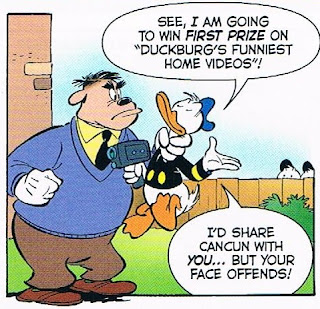

In my review of "Shiver Me Timbers!", I wrote that Bas Heymans' arct struck me "'40's Barks filtered through Marco Rota and Ben Verhagen". The younger Heyman, Mau, shows similar sensibilities in "Wrecks, Lies and Videotapes" – there are a couple of Donald poses that, if you showed them to me by themselves, might just fool me if you told me they were Barks. However, here, Daan Jiipes springs to mind more so than Rota and Verhagen, though there's definitely still some Verhagen-ness in there somewhere. Written by Mau with Kirsten de Graaff, this is a Barksian 10-pager in both form and essence, in every aspect of Donald's latest get-rich(and famous)-quick scheme (which, complementing the lead story, he rushes into bullheadedly, failing to heed the nephews' cautioning), to Daisy trusting something to Donald's care despite her apprehension, which he stumbles his way into vindicating, to Donald's altercations to Neighbor Jones, to the innate social satire of the "old hen"-esque "snobs from [Daisy's] ladies' club" (or "corpulent hippo" club – harsh, Gray!) ... and finally, in the way all the separate threads dovetail and come crashing together in one big, pure Donaldian calamity that ends in his humiliated defeat, with the footage Donald had thought he had taped over ending up on the air and embarrassing the ladies' club, whose members quickly burst onto the scene out for blood, led by Daisy, so utterly let down by Donald yet again. To add insult to injury, Jones ends up winning the contest, with footage he had furtively taped of Donald's earlier trouncings –a twist that, in a very Barksian fashion, had been planted between the lines (or panels) when Jones got wind of Donald's scheme. Yes, Donald's near-success is swiftly unraveled two-fold. (I think there's a mixed metaphor in there...) In setting up these layers and choreographing their intertwined resolutions, Mau and de Graaff's story construction is worthy of the Duck Man himself. Some might contend that it's too beholden and deferential to his work, but it's certainly no shoddy knockoff!


The whirlwind of anguish, humiliation, anger, and anxiety immediately spurred by the unfortunate broadcast quickly funnels down to the ladies' giving Donald chase, tearing his clothes as they lash at him. From the very beginning of the chase we jump ahead to and end on a naked, nervous Donald desperately clutching to buoy he's been driven to, a few yards out past the pier, from where the ladies' club members chide him and mock him as he pleads for his jacket, his face red with shame. (Hey, looks like that was a touch entirely added by colorists Sanoma and Travis Seitler. Kudos, guys!) The story could have ended with Donald fleeing for his life, which would certainly get the point across. But Barks would have doubled-down with one final gag showing the less-than-ideal circumstances Donald has been forced to seek refuge in. Mau and de Graaff have taken a cue from the master in making sure they go out topping themselves, and this closing cross-page panel is very well-composed, telling a story in itself – or at least what had happened since the previous panel.

The perspective line is plotted so that we're to the side of and slightly behind Daisy's ladies, who are positioned in the foreground across the rightmost two-thirds of the panel, looking with them out at Donald. Or, think of it like this: We're standing facing their left shoulders, but turning our head to the left so that we can keep see Donald. He may look far away, but of course, he's just drawn smaller and higher up from the bottom of the panel than are Daisy and Co. – I know, I know, we're talking Perspective 101. By basing our vantage point on par with that of the ladies, it's quite palpable how they've used their numbers to strongarm him into exile literally beyond the fringes of Duckburg society, while they continue to enjoy having their feet planted on dry land.

Poor Donald. He may have gotten carried away in his zeal to win the cash prize, but he never actually meant to hurt him anyone.

-- Ryan

Sunday, May 10, 2015

New comic review: Uncle Scrooge #1 (#405) (IDW, April 2015)


Despite the four-year interim and the change in licensee, Uncle Scrooge #405 is pretty consistent with #404: the spotlight is on a Romano Scarpa-drawn story from 1996, represented with a new cover by Giorgio Cavazzano. David Gerstein was working on the book then, as he is again, but he's reclaimed his archival editor title from the Gemstone days. He's accompanied by Jonathan Gray and Joe Torcivia, two of his teammates from the "classics"-branded aspects of the 2009-11 licensee (though not US #404 in particular), further closing the gap, and bringing a certain level of reassurance to fellow fans who know them.


Rodolfo Cimino and Scarpa's "Gigabeagle: King of the Giant Robot Robbers" (its new American title, paying homage to Barks' own Beagle Boys-giant robot story from only a year earlier, and I suspect that the "Giga" prefix is a reference to some of sort pop culture giant robot that that I don't know about) definitely has a gargantuan Beagle Boy robot stomping across Duckburg and making off with the money bin, but there's not much of a plot facilitating those events. The setup is arbitrary on multiple fronts: we open on Scrooge freaking out arbitrarily over the general existence of the Beagle Boys ... not because of a specific recent  threat from them, and not from news of a prison break or intel on their latest scheme, but from the lack of any news about them. The nephews arbitrarily decide that they will set Scrooge at ease by bringing him to Donald and their house, where for some reason he wolfs down all of the food they can pile on his plate (Scrooge has a binge eating disorder? Or does he just normally starve because he's so cheap?), and then arbitrarily decide that the ultimate solution to his anxiety is to take him camping. The actual plot reason for this camping trip is for the ducks to discover the robot ... because that only could happen if they went camping, right?

But this fast-and-loose, half-assed plotting has nothing on the story's resolution: "Gigabeagle" has gotten away free and clear with the bin, and so it would appear time for the final act of the story, in which the ducks will figure out a way to take down (or take control of, as Scrooge did in this story's Barks precedent) the marauding skyscraper-sized motorized machine with the visage of a Beagle Boy and regain possession of the money bin. Suddenly, in one fell swoop, "Gigsie" is destroyed and the money bin is back on Killmotor Hill. Gigsie's explosive end delivers on some clever foreshadowing. I'm not sure if the "he was programmed to think like the Beagles, and so it was their greed that in the end brought about their defeat" angle was in the raw translation, but kudos to Jonathan Gray if he layered it in. However, I have a nagging suspicion that Gray saved the restoration of the money bin from being a jaw-droppingly absurd, improbable coincidence. Going by the art alone, it would appear that the explosion hurls the money bin over Duckburg and right back into its original position. This is only justified by the "big underground magnets [that] hold [the] bin to its foundation" mentioned by one of the nephews on pg. 3. Since these magnets, as far as I know, have never existed in any other story, and because they're only mentioned in passing in this new English dialogue but never shown, yet, at least as we Americans are reading it, are so crucial to the story's resolution, it seems to me that Gray salvaged an atrocious ending. However, if the mentions of the magnets are in fact mirroring the original Italian dialogue, I'll stand corrected.

(There's also the matter of the nephews for some reason signaling the police with the tiny flame of a common wax candle, but I'm gonna chalk that up as just some Italian thing.)

Nonetheless, Scarpa's art, which has a lot of busy, frantic, exaggerated, comedic hijinks, is a lot of fun. His big, bold, sweeping style certainly works well for giant robot action. Between that and all of the electrified panels of the ducks scrambling to stave off Gigsie's attack on the bin, things move with a rollicking momentum, ensuring that IDW has made a big splash in bringing back to the States not just Uncle Scrooge but the whole classic Disney comics line.

The best of Scarpa's art, with all its zest and zing, is brought out by the zing and zest of Gray's dialogue, which demonstrates that he knows duck comics inside and out, and not just because of the many references to the medium's past ("Wak!" is never exclaimed in this particular story, but the radio station that Scrooge tunes into uses the call letters "K-WAK"; when Scrooge bashes his own head against the wall to get ideas, he acknowledges that a similar technique is used by a certain inventor; the Beagle Boy love of prunes comes up, as is only right; and even a reference to the title of Barks' first Uncle Scrooge adventure), but due to the Barksian dialogue -- and by that, I don't just mean particular phrases like "Good work, infants!", but the cadence and rhythms, and the way tone and timbre signifies characterization, which is perfectly consistent with the characters that we know. And though there are some modern quirks (a reference to a Red Bull advertising slogan and terminology like "A.I."), there's a lot more absolutely delightful eccentricities that would seem to belong to Barks' or even Gottfredson's era but as far as I can tell, are original: "GREAT HOWLIN' CRASHWAGONS!", "Hot crawdads, Unca Donald was right!", "We need that salty codger alert!"  Gray also does a fine job continuing the tradition of comic book tradition onomatopoeia, both in the expressions used and the way they're puncuated.

And I would be remiss if I didn't mention Gray's DuckTales references: there's a variation on Scrooge's "Jumpstart my heart!" and a pun on the name of the Beagle Boy who most of often led the gang on the show. It should go without saying that I appreciated these!


The original Italian title of #405's backup story translates to "The Secret of the Coat", a dry title that evokes the mystery-adventure genre, when the story is actually more in the sitcom vein. So Joe Torcivia's new, comedic title, "Stinker, Tailor, Scrooge and Sly" (I just figured out what that's a pun on -- it's something I'd never heard of; I won't give it away, so that if you have, you can relish it; and if you haven't, do your own damn Googling!) is more fitting for this light-hearted romp with the mismatched "odd trio" of Scrooge, Brigitta, and Jubal Pomp built around a cliché: finding a treasure map drawn on one's own piece of property and unraveling its mystery while clashing with a mysterious villian who who has shown up out of nowhere and we learn is connected to the map's past. Now, this is the stuff of countless exciting, full-developed stories in feature film, pulp novel, and duck comic, but this particular narrative offers little more than a couple chase sequences, with the good guys and the bad guy sparring in a game of "hot potato" (or football) with Scrooge's coat, and the villains' anticlimactic surrender to the police ... for which Scrooge and Co. are basically just bystanders!

On top of the banal narrative, this is recent, slicker, more on-model Scarpa, which I find duller than his squashier '50's and '60's work. By far the most vital, entertaining part of the story is the dynamic between Scrooge, Brigitta, and Jubal, with Scrooge having an aversion to both (but for different reasons), Jubal making no secret of his distaste for (and envy of) Scrooge, Brigitta's crush being tempered by her indignance at Scrooge's stinginess and his contempt for her, Brigitta and Jubal agreeing to suck upand  pander to Scrooge in the hopes of cajoling him into investing in their business, and Scrooge tolerating their scheming so as to use them for his own ends -- first for a complementary coat mend, then the use of Jubal's car when chasing the villain, which Jubal and Brigitta join Scrooge in, hoping to get a cut of the treasure. In the last panel, it appears, via the illustrated thought balloons, that all three parties have played each other and made the right compromises so that each is (at least anticipating) getting what they want. If it weren't for these visuals, the Scrooge-Brigitta-Jubal dynamic would have been out of play at the end of the tailor shop scene, for their tagging along for the arrest and subsequent finding of the treasure would be, as Scrooge describes Jubal in my favorite of Torcivia's jokes in story, "superfluous" to the plot.

Torcivia steadily delivers puns and various other types of wordplay, references (including ripping on Minnie Mouse -- more the Minnie Mouse of mass merchandising than anything -- and her taste in clothing design), and irreverent goofs on everything from "mall cops" to the fashion industry, giving American readers a feisty read. As Gray fixed what I was suspect was a massive hole in the lead story, Torcivia not only ties Barks' Brutopia into the villain's back story, but with said back story, assures us that the map has only been a part of Scrooge's coat for 10 years and not since he acquired it, avoiding any flirtation with dicey continuity. Based on the characters' poses and instructions, the characterizations of the "odd trio" were very much part of the original story, but with all of the insults, jabs, and acerbic sarcasm thrown between them, Torcivia maximizes the potential. I'm not sure why this unexceptional story (though Torcivia has added a lot of tasty seasoning for flavor) was selected for this issue. But if the idea was to begin IDW's run by establishing to the readership Brigitta and Jubal as characters, and moreover their entrepreneurial partnership (for we've seen a fair amount of Brigitta here over the years here, and not too much of Jubal), then it's a very suitable choice.

Gerstein closes the issue with an editorial reviving the "Crosstalk" banner, which definitely made this fan feel at home. After giving some background info on the Beagle Boys, Brigitta, and Jubal, Gerstein closes by sharing a sentiment that affirms that these comics are in expert, loving hands.

-- Ryan

Sunday, May 4, 2014

(Some of) my assorted thoughts on: Uncle Scrooge #320 (Gemstone, cover date August 2003)

During the earliest months of the Gemstone era, to which this issue belongs, I was in college, and, though a few years earlier I had lost interest in comics as Gladstone II was easing into its prestige format-exclusive final leg, I was still excited about the return of the comics that I had grown up reading and loving. But, the whole reason that I had gravitated away from comics in the first place is because during high school, I got this notion in my head that the only way to be sophisticated was to like bleak music, art, and literature created by (totally never posturing) tortured souls. So, Gemstone's bright, colorful aesthetic and the light-hearted, good-natured-but-not-naive, sometimes-subtly-cynical-but-never-outright-despondent stories just didn't jive with me. Why did I remember these comics as being substantive, when now, I could only get very little out of them? 

Well, the problem wasn't the comics -- it was me. I had completely failed to realize that part of the process of growing up was getting stupid ideas and making stupid decisions, and then taking a while to figure out that they were stupid. (Some people never figure that out, I'm afraid...) I was preoccupied with image and a superficial notion of what an intellectual and "artistic" person should be. I'm grateful that in the years since, I've matured and become more well-rounded. And being more centered, I can see an issue like this for what it is: a very solid one, brimming high-quality, quietly satiric, witty, well-crafted stories. 


First up is William Van Horn's 16-page "Fools of the Trade", which is very un-Barksian in the sense that it centers around a one-shot character whose an object of completely fantasy and whim: a talking dragon. Of course, it's Van Horn's wont to engage with outlandish content ... but always with a decided sense of irony and parody, and this story is certainly in keeping. The idea is that that "high-tech" defense systems have invariably failed in staving off the Beagle Boys, so Scrooge has decided to go "old-school", and import a dragon "cloned from the claw of" one of its antecedents. (So, Van Horn has gone a semi-scientific route -- it's not like he's just having dragons suddenly romping around in abundance in the modern world. And it's consistent with his absurdist approach that this explanation is tossed at us dismissively and in passing.) To Scrooge's disappointment, the dragon -- "Figgy", "short for Figment", a clever Disney reference -- turns out not at all as expected, not much larger than one of the nephews and to have a dopey, aloof personality. This twist has a Jay Ward flavor to it.

(The deliberately anti-climactic -- turning the convention on its head -- half-page splash of Figgy nonchalantly strutting out from the darkness of the crate in which he was delivered demonstrates perfect comic timing. I think it'd have me in a slight fit of giggling if instead of exclaiming, "Howdy do, folks!", Figgy were to utter simply, "'sup?" [There's a Paul Dini-scribed issue of Detective Comics that uses basically the same gag, but with the Joker.'] However, I'd probably be adverse to the use of such overly contemporary slang.)

Writers of lesser skill might (in probably a considerably shorter story) have the revelation of Figgy's non-threatening presence be the entire punchline, and maybe, if at all worth his or salt, proceed to end on a gag in which Figgy is able to keep the Beagles away from the bin after all, just not in the way Scrooge had originally hoped. (Taking an aspect of Van Horn's superior version, Figgy's diet consisting entirely of beans, it could be Figgy's breath being really repulsive... or... well, fart jokes aren't really a part of duck comics, so...) Fortunately, Van Horn's talent has given us a much busier, more complex tale involving the Beagles' scheme to acquire Scrooge's cash with a matter transmitter going awry due to their own bungling and complications arising from Figgy getting mixed up in it, resulting in a storm of confusion on both the ducks' and the Beagles' ends. This is a first-rate, silly-but-clever, slapsticky-but-witty Van Horn spoof! The Beagles' being sick of eating beans and accidentally transporting Scrooge's bean supply to their hideout strikes me as a Barksian twist, although I can't help but think that Barks would've saved it for a master stroke a the very end. However, Scrooge does tie things in with a bean-alluding closing one-liner -- and that remark being couple with the last panel's depiction of the Beagles' punishment, and their "Should've been careful what you wished for"-begging remarks that they're sick of the very sight of money, has enough of a Barksian tinge to it that it's still makes for a strong conclusion. Actually, one could say that it's Van Horn enough to be a strong ending, or that it's just a strong ending, period.

The very idea of the Beagle Boys relocating the contents of the bin to their hideout immediately brings to mind the DuckTales episode "The Money Vanishes". The resemblance is all the more closer because in both cases, t he Beagles are using an apparently abandoned urban building (whether it had originally been used for offices, tenements, warehouse or storage, or what have you, it's not clear in either case; the one on DuckTales -- which appeared in multiple episodes -- is worn down and boarded up, while Van Horn's is merely nondescript; the DT one is three stories high, while its hard to tell if the one in Van Horn's story, and those on either side of it, are one or two stories), and in both cases, the Beagles ultimate undoing is that their building becomes overloaded with cash and it bursts out onto the street.

Oh, and I think I might know a guy whose family owns the bean company that Scrooge orders Figgy's pay/feed from! ;)

_________________


"Fools" is very well complemented by the 15-page 1981 Disney Studio production "The Big Break-In", written by Carl Fallberg and drawn by Romano Scarpa -- an international collaboration! Unlike many of Scarpa's duck stories that have made it to the U.S., this one actually makes sense -- I guess its to be expected that a U.S. writer such as Fallberg would be more on the same page as a U.S. audience. The proceedings here are notably sillier than Fallberg's average Mickey Mouse adventure-mystery, although perhaps it's Scarpa's exaggerated, tense poses and expressions that play up the frantic energy the story projects. Taking into account the notion of Scrooge's safe combination tumblers not lining up right because the money in the bin is imbalanced and causing a tilt, and Scrooge counting on the Beagles succeeding in breaking in to solve his problem and sitting back against a tree and taking a nap while he lets them go to work, the high-strung Gyro scrambling to find a solution while the calm Helper accidentally discovers one, and Gyro blindly bringing Helper's solution right into the Beagles' hands, this is a very acutely written, original story -- basically, all of the adjectives that I used for the Van Horn story apply here! The characterization is dead-on, too ... Fallberg should've done more duck stories!

_________________


Barks eight-page "The Madball Pitcher" from one of his Gyro Gearloose issues of Four Color (#1095, 1960) is certainly preferable to those Huey, Dewey, and Louie soccer stories that Gemstone would later feature. However, I question that Gyro never feels guilty for helping both teams virtually cheat ... but in a way where the two inventions cancel each other out! This might be explained as Gyro's exasperated, miserable, "I'm in for it either way" attitude eclipsing any moral concerns that he might have. (I also have a feeling that the way Gyro's characterized here is a reflection of his creator, who revealed a certain degree of self-deprecation fuddy-duddiness in interviews.) But notably, the ending finds both teams at each others' throats -- in a way, both get their comeuppance, but at the same time, they don't seem to have realized that they both committed the very same crime. Safe to say, one of Barks' more cynical moments!

_________________


Geoffrey Blum's writing and Daniel Branca's art guarantee a fulfilling read, but "World Wide Witch" dares to do something I'm inherently wary of: "bring the ducks into the modern world". In fact, the technological references that this story is saturated with are now dated and quaint! Furthermore, it still feels very much like a duck story; even a Barks story. (And it's certainly more tasteful than all of those recent Italian stories that I've seen in which the ducks and mice are seen using smartphones and Facebook-type social networking platforms.) 

Blum treats us to a very thoughtful, insightful, enjoyable one-page article explaining the origins and goals of his story. Blum's observation that Scrooge and Magica "are two sides of the same coin" turns into a confession that he identifies with both on the terms that they're "self-dramatizing outsiders laboring away at specialized careers and venturing into society mainly when they need something from it". Personally, I identify to a T with Blum's self-description personified as his personal interpretation of two of Barks' creations ... which corroborates with the understanding of the characterized that I've acquired over the course of my life to date, and, by extension, to their creator. Thus, it all kind of adds up here: why Blum has always been so well-suited to writing about Barks, and while I've always been drawn to Barks, and to Gladstone/Another Rainbow's Blum-dominated contextualizing of Barks. (Perhaps it's more true than not that I've actually grown into relating to all of this.) ...hey, how did this review become so much about me?! I feel so naked now!

-- Ryan

Wednesday, March 14, 2012

Retrieved From Storage: Donald Duck Adventures #19 (Gemstone, July 2006)

I've mentioned in past posts that for most of the Gemstone era, I'd quit reading and collecting comics for the second (and, as far as I'm concerned at the present moment, last) time in my life. Over the past couple years, I've been catching on what back issues I've been able to find in a couple shops in Connecticut.

Recently, I read this issue for the first time. I enjoyed it, and found much to commend in it, more so than on average. Here's the cover, attributed by Inducks to Massimo Fecchi:


The style in which the regular characters, Donald and the nephews, are rendered, especially with the slick digital coloring and the shading effects, resembles how they would appear in (relatively) modern, "official" Disney studio-produced animation, no? (I suppose DuckTales -- especially the more cartoony, elastic-y later episodes, or the series of Christmas-themed direct-to-DVD specials, would have to be our primary points of comparison.) The immediacy of the perspective and the emphasized action also contributes to the drawing's (psuedo-) animated quality.

_______________________
 
 
With its depiction of the ducks being menaced by a Viking warrior, the cover shown and discussed above represents the lead story, "Where's the Bin Been?", written by Pat and Carol McGreal and drawn by Flemming Andersen. Dominated by time travel, it's a compelling (and worthy) counterpart to "The Bathtub at the End of the Unverse"/"The Bathtub at the Edge of Forever", published only two issues earlier, in #17, and which I wrote about (and gave high praise to) in a previous post. Interestingly, "Bathtub" was also drawn by Andersen, but written by Michael T. Gilbert. Nonetheless, both stories share similar characteristics of inventiveness, sharp plotting and characterization, and balancing high-stakes drama with humor that seems to naturally proceed from the plot and characters.

Time travel stories are commonplace in comics and other mediums in which genre fiction prospers, but to my delight -- avoiding spoilers -- the time travel scenario that the McGreals devised here is original and exceedingly clever. (Hint: the dilemma/conundrum that spurs the plot rolling is inevitably resolved at the end, by way of a twist reveal. Let's just say that the history of the money bin's presence in Duckburg ends up considerably retconned!)

Of course, a lesser writer would send the ducks on this particular mission, assume that the plot could carry them, and have them act more less like robots acting together as one. Of course Scrooge wants to figure out where his fortune's gone and recover it ... but his shifts between, depending upon how things develop from one beat to the next, despair, gung-ho determination, and mortal fear are dead-on (especially with Andersen's exaggerating renderings -- when appropriate, Scrooge's visage is comparable to the famous painting by Evard Munch, "The Scream"!)

Donald's eagerness to get this particular adventure underway at first strikes one as being a bit out-of-character. But the McGreals sell it once it becomes apparent that his pop culture indulgences have inspired him to brazenly, myopically pose as a brave adventurer. Once the ducks are faced with the Viking threat, Donald even goes so far as to pose as a Norse god ("Those bozos are a superstitious lot! They believe in gods like Thor! I should know! I read the comic books!"), delusionally certain that he'll immediately scare them off. (And then it goes nothing like he'd thought it would. Who ever would have seen that coming?!) Jeopardizing the mission and causing Scrooge several more heart attacks, the dissonance between Donald's slacker "unseriousness" with Scrooge's disciplined, shrew, miserly "seriousness" is well in keeping with Barksian tradition, expertly staged in a way that's unique to and integral to this story. All the more admirably, the failure of Donald's disguise proves to not be an arbitrary, passing gag, but a well-laid-out plot thread, and the crux of Donald's role in the story, coming to a head as one of the mutually complementing multi-twists of the climax and denouement.

Like so often in Barks' stories, the nephews are dedicated to assisting Scrooge in his objectives, scrambling to solve problems when they arise and more than once making deductions before the two adult ducks do -- in other words, being exemplary Junior Woodchucks. However, the McGreals -- and possibly even more so -- Andersen never mistake the nephews for conditioned, reflexive little soldiers. When the ducks are in a jam and a solution isn't yet apparent, the nephews are obviously worried and/or afraid. They're human (...for all intents and purposes!), after all.

_______________________


Make no mistake -- I thought that "Where's the Bin Been?" was great. Still, the story that really solidified my favorable disposition to this issue was its second feature, a Mickey Mouse story, "The Wind of Azalai", written by Augusto Macchetto and drawn by Guiseppe Dalla Santa. Though I'm not familiar with either creator, they did a bang-up job! I am perfectly fine with, in general, the heavily exaggerated, highly stylized art that typifies many, many European Disney comics, and I consider folks such as Andersen (as evidenced above), Cavazzano, etc. to be exemplary cartoonists. Nonetheless, I'll admit, sometimes it's just plain refreshing to see these characters, and an entire story, drawn in a "conventional", more "straight" fashion, as Dalla Santa does here!

Furthermore, this is a classical adventure story, set in the unforgiving Sahara and replete with an ancient mystery, a hidden civilization, the revelation of unexpectedly advanced ancient technology and science, and ruthless desert-dwelling hordes of rogues/bandits! In other words, it's right up my alley! The plot point of Mickey and Co. getting lost in a ferocious sandstorm and winding up held captive in the aforementioned "hidden civilization" brought to mind DuckTales' "Master of the Djinni"! Consequently, at first, I was sure that the storm had transported back in the time, and some of the more dramatic score music used heavily in DuckTales' adventure-dominated first season crept in to my head, and stayed there `til the end of the story!

Admittedly, it's a bit more contrived than "Bin Been?" But the ultimate solving of the "gold and salt" enigma is clever and original enough. The story's strongest point is Macchetto's conception of, and Dana Salla's depiction of, the underground wind tunnel and air-raft.

_______________________


Most issues of Gemstone's Adventures digests encompassed three lengthy, solid European stories. However, after "Azalai", the rest of the issued is filled out by a few shorter works and a smattering of gags, ranging in length from one to several pages. When I realized this, I balked, but overall, I discoverd that the material held up quite well.

A Beagle Boys story, "The Black Sheep" entailed qualities of whimsy, absurdism, and yet kind-natured earnestedness that reminded me of Sergio Aragonés. Writer Francesco Artibani's posits two Beagles Boys' relating to Grandpa Beagle how it happened that they "blew another caper!" Their narration is contrasted against a visual flashback that the readers, but not Grandpa, are privy to, revealing what they're leaving out and how they're downplaying their follies. Somewhat Rashomon-esque, Artibani gives the time-tested "disparate account" trope his own spin. Realized via Silvia Ziche's distorted art, in which little is rounded, opting for pointy angles and blocky shapes, and favoring over-the-top, frenzied poses and facial expressions, this is a tasteful example of slapstick and comedic characterization.

The standout of the issue-rounding-out lot, to me, was "Inside Donald Duck" -- another Andersen-drawn story, this one written by Mark and Laura Shaw. Yet again, Scrooge and Donald's differences are played up, this time to the hilt -- the phrase "oil and water" doesn't even begin to capture how badly things go here, all as a result of them being unable to get along and driving each other (...or, perhaps more aptly, themselves?) incrementally crazier and crazier. In fact, the story's opening brought to mind that of "Back to the Klondike": set in the bin's office, something -- naturally, involving his money -- goes wrong, and Scrooge panics, to the point of hysteria ... though in "Klondke", Donald was a bemused bystander for Scrooge succumbing to his neuroses, here, they're i.e. at each other's throats. The blundering escalates, resulting in the necessitation of a visit to the doctor's office -- the next scene, which we promptly cut to.

Breaking away from the "Back to the Klondike" parallels, the doctor fails to help Donald ... thus, the really bad thing that Donald had happened is still really bad, and so he's nervous wreck, and the really bad thing gets worse and even more worse, and it turns out that this is one of those "Donald tries to do something right, but he messes up, and before you know it, he's left a path of destruction clear across Duckburg" stories. And it's one of the highest order! It's tightly plotted, and masterfully executed on the visual end of thigns by Andersen -- I'll repeat what I said said about Ziche's "Black Sheep" art: with Andersen's "distorted art, in which little is rounded, opting for pointy angles and blocky shapes, and favoring over-the-top, frenzied poses and facial expressions, this is a tasteful example of slapstick and comedic characterization."

As the issue winds down, we encounter a six-page Romano Scarpa Mickey Mouse story. To me, it tries a little too hard to be some sort of humorous moralistic fable, but it comes off as hamfisted, and its attempts at twist plot points and irony are a bit too forced. Originally from 1973, the incidental dogface characters (a crook and two police officers, the crook and one of the officers with the portly shape Scarpa often uses that I think was inspired by Gottfredson's Chief O'Hara) hint at Scarpa's funny animal cartooning at its best. But on the other hand, Mickey looks a little strange -- it looks like his snout's been mangled! Finally, just who the heck is this "Ellsworth", an apparent sidekick or partner of Mickey's!

And then, the issue closes out with two decent/average one-page gags. To keep things proportionate, that's all I'll say about them! :)