Showing posts with label David Gerstein. Show all posts

Friday, June 24, 2016

New-ish comic review: Uncle Scrooge #419 (IDW, June 2016)


IDW: If you keep having both the A and B cover reflect the contents inside, 
I'll keep buying both! (And glad to help sales that way!)

"Scrooge's Last Adventure" Part 3
written by Francesco Artibani
drawn by Alessandro Perina
lettered by Nicole and Travis Seitler
new U.S. dialogue by Jonathan H. Gray
(Italy, Topolino #2987, February 26th, 2013)

When the support of Scrooe's in Part 2 pushed him out of his post-defeat slump and he vowed to fight back against the cabal that has robbed him of his financial empire and dignity, he meant it. Part 3 finds him practically marching through the Gates of Hell Pluto and into the Realm of the Council of Dark Magic. While Donald is understandably scared and Magica is walking on eggshells around her former masters, Scrooge bullishly confronts the Council like their secretaries or bureacrats standing between him and a rival CEO he's determined to confront -- and the comedic contrast between Scrooge and the more on-edge Donald and Magica is one of Part 3's hightlights. Another is the battle of wits against the Council that Scrooge wins -- a fine entry in the "Hero moves onto the next phase of his Hero's Journey by overcoming an intellectual challenge from a physically large immortal Guardian of some sort" tradition hailing all the way back to Oedipus solving the Riddle of the Sphinx. Kudos to Gray for the intelligence and complexity of this exchange, and how charmingly in-character the asides between Scrooge, Donald, and Magica were.

And said next phase consists of -- a surprise new encounter and new outing with the Terries and Firmies(!!!) Scrooge and Donald in order order help the subterranean part-bowling ball ones solve a major environmental crisis that'd beset them, the culprit turning out to be none other than... Glomgold. This reveal nicely ties Terry-Fermy episode into the wider story arc as a whole. In my review of Parts 1 and 2, I compared "Last Adventure" to the ill-realized "Rightful Owners" DuckTales four-parter. That disaster had attempted to revisit a couple of classic Barks adventures, too... but Artibani's return to the land beneath the ground is succintly and fully-realized, and packed with the requisite "mass roll" action by Perina, its place in the larger story balanced and in the proper scope, a deflty-paced and rollicking run-up to final chapter. Scrooge even has his top hat returned to him! (...wait, are you sure Don Rosa never had that happen?!) ;) Gray does a perfect job with the Terries and Firmies' country music FM radio-"learnt" speech -- it felt as though I were reading the original!
_______________

"The Stick-Up"
written, drawn, and lettered by William Van Horn
(New to the U.S. First appearance anywhere in Norway's Donald Duck & Co. #2010-09, March 1st, 2010)

Another Rumps McFowl-oriented Van Horn short making it U.S. debut. Rumpus, inexplicably left in charge of Scrooge's office while he and his nephews are off on yet another adventure (funny setup, that, to have an entire one of those happening off-panel), nearly blows it by making some frivolous decisions to use McDuck funds toward an attempt to win a television promotional contest -- but inadvertently foils a near-successful Beagle break-in plot, while winning the contest... which ends up benefitting Scrooge, since he owns the company hosting the contest! Genuinely kooky, clever, quickly-paced, funny stuff, replete with some wacky, calamitous syrup-based purely Van Horn visuals!

-- Ryan

Saturday, May 21, 2016

New comic(s -- in total, 2) review: Walt Disney's Comics and Stories #730-731 (IDW, April-May 2016)


Right: Cover for #730, drawn by Henrieke Goorhuis, colored by Ronda Pattison. Original.
Left: Cover for #731, drawn by Massimo Fecchi, colored by Mario Perrotta.

"The Search for the Zodiac Stone" (#730-731)
Chapter 10: "Blondbeard's Pirate Plunder"
Chapter 11: "The Partners of the Pendant"
written by Bruno Sarda
drawn by Franco Valussi
lettered by Nicole and Travis Seitler
U.S. dialogue by Jonathan H. Gray
(Italy. Topolino #1789-1790, March 11th and March 18th, 1990)

Eleven issues ago (...how time has flown!), I wrote about the advent of the U.S. premier of "The Search for the Zodiac Stone" in terms of expecting some sort of cosmic-in-scope, "ultimate"duck-mouse universe-set "epic". I had no idea what I was talking about, as many a European reader would've been able to recognize 25+ years ago. To a Topolino reader in 1990, this storyline we might imagine was a novelty: for 12 consecutive issues (exactly three months' worth), one story (out of several) per issue, each roughly 30 pages in length, was presented under the over-arcing "Zodiac Stone" umbrella. What otherwise may have read as the latest Uncle Scrooge, Donald Duck, Mickey Mouse, or even Huey, Dewey, and Louie adventure had tacked onto it some jive about the immediate proceedings having something to do with the recovery of 1 of 12 "pedants" (as they've been called int he American version).

The loosely serialized nature of the continuity is driven home by its unassuming, casual, not merely self-contained but self-concerned second-to-last and penultimate installments. Chapter 10 is made of the stuff that accounted for a Huey, Dewey and Louie Back to School or Donald Duck Family edition of Dell Giant: the nephews, staying on Grandma Duck's farm, are bored, so Grandma decides to liven things up for them by faking a pirate's treasure map set right on her farm. On the other hand, even given her temporarily getting the upper hand on Scrooge, Chapter 11 may be Magica's most undignified, humiliating effort to acquire Scrooge's first dime: despite the basis of the magic she uses here in Greek mythology, in effect, it comes off as little more than her commandeering a coin-operated grocery store kiddie ride rocking horse.

Make no mistake, I enjoyed the comedic  seasoned adventurer nephews' expressions of boredom with the plain doldrums of a "hayseed's" existence; Grandma's stick-to-it-iv-ness in not just verbally defending her way of life but going out of her way to orchestrate an elaborate ruse to prove her point; the comic relief found in Gus reluctantly aiding Grandma in aid efforts and in their course becoming far more easily tired than she is; Scrooge's faulty memory ("Back to the Klondike", anyone?) leading both Donald and Mickey around the globe on several false trails; and a despondent Scrooge supplicating a gloating Magica, who is quick to find herself fouled up by the surprise arrival of the Donald-Mickey team. And make no mistake, each and all of these characterizations and interactions were as richly rewarding as they are in the IDW due to Jonathan Gray's exacting scribesmanship.

Whereas in Chapter 10, the "Taurus" theme is incorporated only in passing as part of the opening scene, and later revisited, sort of "tying everything together" at the Whitman-level "dramatic" climax, and has absolutely nothing to do with the respective pendant's backstory, Chapter 11's " " is jutting right into our face, in a glaring, big, honkin' way... yet the ultimate locating of the  pendant turns out to have NOTHING to do with the preceding search for it, in an way that's almost clever for being anti-clever.

So, in all, yes, "The Search for the Zodiac Stone" has ended up being sillier an outing than I'd originally hoped it might be. But it HAS -- thanks to the lively, charming art, dialogue, and characterizations -- been a hell of a lot of fun, delightfully both silly and satirical.

And the final panel of Chapter 11 teases and promises that the next and final installment will see the Phantom Blot teamed with Peg Leg Pete. Let it not be said that "they", in their various permutations over the decades and across the continents, don't know what we want!
 ________________

"Music for Melons" (#730)
written and drawn by Ben Verhagen
lettered by Nicole and Travis Seiter
U.S. dialogue by David Gerstein
(Netherlands. Donald Duck #9-1987, February 27th, 1987)

Perhaps it's because of "Blondbeard"'s low-key nature that "Petrified Perfection" was given  the cover and lead spot over "Zodiac"'s tenth chapter. Whatever the reason, the rare appearance of Ben Verhagen story is a special event in its own right, and being a 10-pager, it being a WDC&S headliner is both appropriate and deserved. Donald pressured to succeed in a new, key position delegated to him by the ruthlessly judgmental Scrooge is a time-tested formula. I wouldn't as Donald only succeeds at the last minute, after a string of desperate, failed attempts. If the intended-to-be-silly efforts to accelerate and compound the growth of a single melon are visually not as silly as they could be, Gerstein's dialogue makes up for it, with numerous pun and turns-of-phrase ingenious in their direct contextual relevance, as well as several very eccentric references (a couple of which I couldn't even figure out). 

Something about the narrative execution felt off to me -- I've pinned it to the fact that Scrooge charges Donald with the entire crop, yet the ensuing efforts are centered on the one melon. Though we're shown what inspired this obsession, it was hard to escape the feeling of established but immediately neglected expectations. Living (and measuring) up to the legend is a still hard sell, as it's not made explicit that the melon icon painted on the fence is supposed to represent the actual size of the historic precedent Don's striving to emulate. 

Ultimately, though, the [series of comedic failed attempts --> fleeting moment of triumph undone by over-the-top disaster --> things turn out okay with a "twist" solution] structure holds things together perfectly fine. The wide-angle, grand, stately depiction of Scrooge's newly-opened giant-melon-refurbished-as-hotel in the closing half-page splash evokes the fantastical whimsy of Verhagen's adventure stories. I don't know if Scrooge in the introductory scene citing the zoning restrictions subjected upon him or the cryptic hint in the legend about "the secret being found in song" were originally part of the story or were worked in by Gerstein, but either way, both lay the ground for a setup-payoff sub-thread -- two integral layers built into the story, giving it more complexity.
________________

"Petrified Perfection" (#731)
written by George Stallings
drawn by Riley Thomson
(U.S. Br'er Rabbit weekly Sunday newspaper comic strip, May 17th, 1953) [newly titled]

Vintage Disney's Br'er Rabbit, a vintage Sunday newspaper comic strip -- how can one go wrong?!
________________

"Why Robot" (#731)
written by Stefan Petrucha
drawn by Fabrizio Petrossi
lettered by Nicole and Travis Seitler
(France. Le Journal de Mickey #2999, December 9th, 2009)

This story's appearance in the U.S. marks a throwback to the Gemstone days, which was heavy with 4-tiers-per-page modern Danish Mickey (and friends/family) stories. Petrucha was one of the writers whose stories were regularly used, and though Petrossi wasn't seen as frequently as Ferioli, he did make a showing, and I would say aesthetically was of that same school -- slick, smooth, and more (pupil-eyed) "Disney traditional" than their stylized Italian counterparts.

Not only is "buddy film"-esque scenario spotlighting Goofy and Horace as a comedic duo sans Mickey or any other regulars a novelty, but so is Horace receiving top billing, shared not. It's practically screamed in the reader's face that if their hosts aren't robots or haven't been body-snatched by aliens, then it's got to be some other equally familiar trope.  But it's not supposed to be an impenetrable mystery for the reader -- it's a farce, the crux of this outing being how, each for his own reasons that are innate but completely different from the others, this pair of sidekicks astray from their "alpha" are both oblivious to and hyper-suspicious of (in a justified but completely misguided way)  of their surroundings.

Because they're both played as fools, we expect all along that whatever accounts for their mysterious glimpses, fleeting window-facilitated of what they take as a "robot's shadow" is most likely innocuous. It shouldn't be a letdown when we're proven right, for all of the dark-and-stormy-night theatrics are meant as a joke -- a spoof -- reflecting each protagonist's childlike, misread perception of the situation and their wild, unfounded hypotheses.

The quintessential moment of this exercises in contrast is the simple-minded though humble nature expressed in Goofy's thought balloon and the overblown ego and self-deluded vanity rampant in Horace's.

-- Ryan

Saturday, May 7, 2016

New comic(s, two of 'em!) review: Uncle Scrooge #417-418 (IDW, April-May 2016)


Left: Cover for #417 by Alessandro Perina, from Topolino #2985.
Right:  Cover for #418 by Ulrich Schroeder and Daan Jippes. Original.

"Scrooge's Last Adventure" Parts 1 and 2 (#417-418)
written by Francesco Artibani
drawn by Alessandro Perina
lettered by Nicole and Travis Seitler
new U.S. dialogue by Jonathan H. Gray
(Italy, Topolino #2985-2986, February 12th and 18th, 2013)

This is what the ill-paced, under-developed "Rightful Owners" four-parter of 2011's short-lived U.S. DuckTales comic should have been... and I think was trying to be. (Not to mention that Rockerduck unquestionably belongs in an Uncle Scrooge story, whether properly cast -- as he is here -- as one of Scrooge's arch-nemeses, whereas his comparable (unprecedented) involvement in "Owners" was... puzzling.) One of if not the most recent Italian duck stories that IDW has printed, it reveals that Italy's most popular comic is keeping pace with its American counterparts, in terms of "big", blockbuster-level stories that bask in the mythologies of the respective headlining stars and their universe, playing to a cumulative archetypal conception of them given a new spin, the figurative "money shot" being our hero faced with a harrowing day of self-reckoning and/or devastating crisis and defeat that speaks directly to and underlines their "core essence". Strictly in terms of Batman, a definitive example of this kind of thing would be "Night of the Owls"; or its slightly-less-modern (and now virtually legendary) progenitor, "Knightfall".

Getting back to the DuckTales comparison, I find it apt as even though the TV is now considerably more dated than I ever imagined it'd become, in conceit it was always a more Hollywood incarnation of the duck comics... and with "Scrooge's Last Adventure" (ahem, this 2013 Italian four-part serial, not the promising but sloppily executed 1990 DuckTales episode), that objective and approach has been reinvigorated and brought up to speed with competing popular fiction narrative-based entertainment.

Make no mistake, a part of me (a considerable part) is almost militant in my ideological inclination toward a Barksian-Rosian purism (the "-ian" part is quite deliberate -- far from rejecting anything not by the Duck Man and his celebrated #1 fan and successor, I embrace the European stories crafted by Jippes, Milton, Verhagen, Branca, Vicar, the Heymanses, etc. because of their familiarity to and with Barks' universe.

Nonetheless, how can I not enthrall to seeing my favorite characters in such a rollicking, accelerated, hyper-ized form so drastic and heightened in scope? Seeing the secretive reaching-out-and-assembling, hand-playing, give-and-take compromising that nets the super group allying of Scrooge's four unqualified hallmark arch-nemeses; the execution of their strategically coordinated, multi-front assault on Scrooge and his bin hinging on their game-changing role-switching; its paradigm-shifting success; the defeated, depressed Scrooge casting a pall over his shaken but (touchingly) supportive nephews, soon to feel the ramifications of the villains' triumph themselves; the concurring intricate clashes of wills, agendas, and statuses (the Beagles and Magica each in their own right tossed aside as tapped-out patsies "rewarded" with pointedly misfitting new trappings), exacerbated by their innate mutual distrust, forcing the web of inter-group conflict to thicken; and both fantastical, big-stage Magica-centered show-stoppers (in Part 1, a would-be-but-dud-fated Battle for the Ages over the dime in the bowels of Mt. Vesuvius; Part 2, a Tolkien-cum-Lovecraftian face-off with an apparently sugar-averse monster posted guard at the gates to the underworld of the sorceress trio comprised by Magica's superiors.

The answer? (Wuh...? ...ohhhhh, yeah! I was asking a question! Huh! Who could remember that?!) I have no choice but to -- there is no conceivable reality in which I cannot -- eat this shit up! I even -- for the first time, EVER -- not only accepted and was sold on Duck Avenger being a part of Donald's existence and Duckburg's schema... I found myself actually liking the whole deal! Hell, I was cheering him on!

Despite my excess use of flowery language, I'm absolutely not dressing up and agrgrandizing any of the scenes, concepts, characterization, or "ultimate character mythology moments" I've alluded to. I'm but recounting what's in the comics -- what Artibani and Perina are doing here, and doing in spades. The complexities of Artibani's ambitious overarching plot and its several inextricable subplots are the stuff of grand vision complemented by acute clarity and finely-honed execution. Perina's art is unmistakeably "duck comic Italian" in its late '90's/early '00's Cartoon Newtork-ness, but deceptive in its simplicity, for his action is fluid and precise, bolstered by his exacting, exceptional, original, rich-in-depth "camera angles". The latter, however, are so purely servile to the narrative, one doesn't notice them -- "cinematic" framing and composition is the post-Watchmen comics norm, but to employ this approach in a duck comic and trick you into thinking you're reading a more-or-less traditional shows the hand of an artist who in this respect is truly good.

Also and in kind, it's important to note how the state-of-the CG coloring done at Digikore Studios is as (pardon the expression) cartoonishly bright and "solid color"-predominant as we've come to expect of modern Disney comics, but the faux-shading is more sophisticated and nuanced than were these comics' four-color ancestors (even very recent one), but is subtly layered to the point where one is thinking, as he or she would in the Disney Comics era, "Hey, they're trying to be modern but its beyond their means." It blends in. It works. (E.g., the shadow that's fallen over Donald's house in the left foreground in just the opening panel of Part 2.) And it adds to that vivid, "rich", "cinematic" "depth" (quoting myself) in Perina's panels, working together for the comic, not against it.

(And those Seitler letterers, they're all on top of and "rocking it" in doing their job, too!)

A couple other "quintessential" bits/scenes that must be noted:

1. All of the duck family and a few familiar friends and acquaintances rallying around the resigned Scrooge at his and his nephews' place of refuge, Grandma Duck's farm can easily be transposed in my mind to being enacted by the "duck cast" variant that is DuckTales' cast.

2. In fact, much like the nephews, Launchpad, Mrs. Beakley, Webby, and Duckworth's visit to Scrooge's jail cell in DuckTales: The Movie reinvigorates him, quickly and decidedly resolving to double down, strike back, and WIN... in "Last Adventure" Part 2, the genuine, profuse concern and encouragement from the extended Italian comic book duck-family-and-friends lineup finally resonates with Scrooge, and he suddenly is restored to the tough-as-nails, ablaze-with-drive-and-determination Scrooge we know and love. I won't mince words: as an integral turning point crowned with an uinhibited, all-in McDuck rallying cry, it's absolutely, positively, wayyyyyyyyyyyy beyond kickass.

...oh, and before his rebound, said scene finds Scrooge pacing afret on a circular rug. Yes, there's a Barks precedent (unquestionably), but I couldn't help but let it evoke for me DuckTales' "worry room"... (I know, I know, I can't help myself...)

When I expressed to one of my grad school professors fondness for the '90's JLA arc "Rock of Ages", citing two specific intentional "quintessential, archetypes" (1. Part Two's cliffhanger ending, in which Batman -- cowl folded back, fully exposing the face of and giving way to the person of Bruce Wayne -- declares that he's going to revert Lex Luthor's thwarting of the League with something that "Bruce Wayne knows best -- corporate takeover" (sic). 2. The reveal, on a dystopian future Earth, that the elusive, anonymous mastermind running the rebel resistance from a computer terminal is a battered, hardened, aged Batman/Bruce Wayne), she remarked that the story as a whole was contrived, strung together by "those big moments", while the themes and seemingly key plot points said moments are meant to crystallize are inconsistently actualized throughout the rest of the serial. I had to admit that I could see her point, so I do at times worry that I'm letting myself be manipulated by the gimmicks that are in actuality what these"sweeps week"-type "event books" are built on. Maybe so. But in my assessment, if the plot can be looked at as a thin string of fan bait, at least with the IDW version, not one of the ultimate product's bones is lacking, thanks to the abundance of meat that is Jonathan Gray's dialogue, the numerous strengths and immense versatility of which has been praised here several times past.

By the way, here's a notably dark (for a duck comic)cover by Perina that was used on a 2014 Finnish book in which the whole serial was collected:


Pretty great, eh? Hopefully, IDW will appropriate it for either Part 3 or 4... or use it for the trade (which not only is an eventuality, but should happen, since a multi-part epic like this one presented in its entirety is originally what a "TPB" was for... and still the only purpose for which one makes sense.)
______________

"Nothing Like It" (#417)
written, drawn, and lettered by William Van Horn
(New to the U.S. First appeared in 2009 -- the April 27th issue of Norway's Donald Duck & Co., Sweden's corresponding April 28th issue of Kalle Anka & Co., and the Danish Anders And & Co. equivalent, dated April 1st but designated by Inducks as the story's "first" appearance. Must have been determined alphabetically ('cause, you know, Anders).

Given how "Last Adventure" Part 1 ends aLocationnd how the immediately-following backup story, "Nothing Like It", begins, a new reader might think the latter to be some sort of "Last Adventure" sub-chapter taking place somewhere in the near-immediate wake of Part 1. (I'm quite sure this not literal but thematic unity was not overlooked by our editors.) New (to the States) Van Horn has become rarer and rarer, so this one's appearance here is certainly a happy occasion. Though relatively simple, modest, and low-key, "Nothing Like It" is simultaneously whimsical, absurd/surreal, eccentric-ly and uniquely funny, and genuinely original and unpredictable. Yes, all odds were that Scrooge could only be experiencing a dream, hallucination, transport to an alternate universe, or anything else but a genuine, real McCoy new day in his and Duckburg's reality (such as it), I couldn't for the life of me deduce what was actually going on or how Scrooge's dilemma would work out -- I was stumped! With the "lima bean and tapioca yogurt" callback and the self-in-joke wordplay to Scrooge's "wise adage" final line, the ending hits just the right spot.
______________

 "For Whom the Belle Toils" (#418)
written by Dick Kinney
drawn by Al Hubbard
lettered by Nicole and Travis Seitler
(Disney Studio program, new to the U.S. Per Inducks, first printing anywhere was in Brazil, 1970, but my alphabetical theory holds up (O before T), because said Brazilian printing was in what Inducks cites as the October 2nd, 1970 issue of that South American nation's O Pato Donald... yet the site likewise notes that its first Italian -- and, I decree, actual first-ever -- printing was in that same year's January 18th issue of Topolino. Unless I'm misinformed, January is the first month and October the tenth month of a given calendar year.) (Trivia gleaned from Inducks: Until now, Italy, Brazil, and Greece were the only countries to use the story, in 1976.)

Belle Duck is back, I found her more endearing than last time, the comedic twist on the last page and the "new anchor" callback closing gag actually amused me and didn't feel forced, and for the most part, Hubbard's ducks aren't looking more appealing and less weird to me. Pluses, all! (I know, sort of backhanded of me, though... I think I'm just restless in wanting to finally be done with this review...)

If a Belle-versus-Brigitta-for-Scrooge's-hand story has never been done, I guess I'll go on the record as saying that it wouldn't be a hopeless endeavor. By the way, re: Belle, think Kathy Bates' Jo Bennett of The Office but with a markedly higher sum measurement of the ingredient of sweetness.

-- Ryan

Thursday, December 10, 2015

Recent comic review: Walt Disney's Comics and Stories #722 (IDW, August 2015)


 Part 2 of "The Search for the Zodiac Stones" finds Mickey and and Goofy exactly where at the end of Part 1 they announced they were going next: Brazil. Goofy admiring a street vendor's display of local pottery and various other "souvenirs" while Mickey stands by, urging him, "Hey, we've got to get goin'!" may sound too casual for a splash panel opener, but Massimo De Vita's art is rife with so much activity, using arresting, dynamic perspectives and original, specific poses and expressions, it works fantastically.

Over the course of the next several pages, Mickey and Goofy meet Tex "Eagle-Eye" Tuckaree, a scatter-brained pilot they're chartering to fly them to the Stickaree village. The ensuing flight, culminating in a head-on crash smack-dab into the jungle, is as tumultuous as our heroes had feared, but to the reader, the sequence is entertainingly rife with first-rate quirky, comedic action. If "Eagle-Eye" (perhaps the best part of that name is not its intentional irony, but how Jonathan Grey's narration toys with said irony) reminds one of Launchpad McQuack, he should -- and indeed, Grey makes the allusion. (It would have almost been a crime not to.) In the flashback relating how Tex lost his eye-sight -- and, it would seem, his mind -- which thus ended his stunt pilot career, it's impossible not to think of Launchpad's backstory as having been one of the Flying McQuacks before he went solo.

The flashback ends with perhaps Grey's most priceless line of the issue (and there's a lot of good ones to choose from): "See how sad that story wasn't? Don't you feel awful for laughing?" In fact, put that way, I'm not sure how I can reconcile how charming, amusing, and fun I found the Tex Tuckaree sequence! However, I do feel vindicated in my having noted that it looks like there's going to be wacky, Rocky and Bullwinkle-esque aspects to this serial

Grey, a proven ace with references (one to a certain kaiju, and at least two in-jokes related to Mickey himself), wordplay ("blights, terrors, and terrored blights!"), and just plain colorful language ("Sweet babies!"; "THUNDERDUNK!"). But he exercises discretion and holds a delicate balance, playing it straight when called for -- notably at moments when plot logistics are established, such as the information the Stickarees share with Mickey and Goofy that allows them to pick up the trail they're following anew, or the news given to them by Cal and Cab about the sale of the Scorpio piece. But playing it straight doesn't necessarily mean playing it dry; as no-frills a line as Mickey's "They left with a canoe, so their trails can't be that cold!" might be, it certainly sounds like the scrappy Mickey we know. (Imagine if he'd said, "It appears that they have taken a canoe, which means that at this point, they cannot be very far ahead of us." Yuck!")

Visually and conceptually, the fantastical, even "trippy" Scorpion Valley sequence -- with its abundance of fumaroles ("baby volcanoes", per Goofy) spewing a gas that induces alarming ocular distortions character by scale wonkery -- is originally and intelligently conceived, especially considering the scientific explanation for -- and solution to -- how the illusions are chemically manifested. Mickey and Goofy going through the process of suffering the effects of the fumes and then figuring their way out of and overcoming this hallucinogenic trap follows a tight narrative arc that's near-perfect in its build-up and unraveling.

And finally -- what, you thought I actually wouldn't cover this -- there's the delightful surprise that comes right after Mickey and Goofy leave the Calloways' camp: their running into Scrooge, Donald, and the nephews, in the middle of one of their adventures, but one that's been going on without the reader being privy to it -- until the moment at which Mickey and Goofy join in! I knew that the ducks were going to be in this multi-part epic, but I wasn't expecting them in this installment. Thus, their reveal genuinely threw me for a loop, but in a very, very good way! Grey made it all the more sweet with his dialogue for the (highly personalized, descriptive) greetings exchanged between first Mickey and Donald, and in the next panel, Mickey and Scrooge.

Leading up to this chance meeting of major players, the reader was teased with the Stickarees' and Calloways' accounts of the "band of five" whose trail Mickey and Goofy are following.  Due to a loss in translation, Mickey suspects Pete and some of his known accomplices and sidekicks, whom Grey has Mickey name (or rather, has Mickey think, think, via thought balloon) as treat for the fans... that is, presuming these references are original to this version. I wonder how in the original version Mickey's elusive was described by the respective witnesses and what were Mickey's thought balloon speculations as to the identity of the group he's tailing.

This all-star team-up nearly eclipses the cliffhanger ending that follows. But let us not overlook yet another example of De Vita's talent -- using a heavily stylized, jagged style that imparts a throbbing jerkiness, the chaotic, violent energy of this geological upheaval almost rages out of the panel borders and off of the page.

One quibble: in Part 1, the Aquarius piece is referred to as Cab's. Here, it's Cal's, the Scorpio piece being cab's. A mistake that will be corrected in the trade, I presume?
________________

At a short but busy, expediently-but-evenly-paced four pages, Evan Geradts and Freddy Milton's "Open Door Policy" follows the Beagle Boys as they steal one of Gyro's latest (considerably more magical-seeming than usual!) inventions in order to use it to -- what else? -- rob the money bin. Being able to effortlessly make their own instant-entrance to the bin is virtually a Beagle's dream come true. There wouldn't be very much conflict if at first they didn't make off with some of the cash, but after some initial freaking out, Scrooge ultimately manages to thwart, in a wildly ironic, perfectly fitting way. This resolution -- like the rest of the story -- plays out with "wham, bang, done" pacing that conveys the Beagles' fated comeuppance in a particularly lucid, stinging way. Maura McManus' dialogue is modest but witty (and in-character), suiting the story quite nicely. E.g., the descriptive, silly names for several of Gyro's silly invention; or the last line of the story, Scrooge, gloating to the Beagles over his foiling them, making a "door pun" that's grin-inducing in a "Oh, you just HAD to, didn't you?" way.
________________

Two gag pieces -- one duck, one mouse -- fill out the issue. In Al Taliaferro's "Demolition Donkey", a sportswear salesman is left baffled by Donald without explanation returning one sport's uniform amd exchanging it for that of a completely, drastically different sport.

Though Mickey behaves uncharacteristically childish in Merrill De Maris and Manuel Gonzalez's 1939 Sunday "Minnie Can't See", it definitely makes sense that the robust, active, outgoing Mickey of the strips -- as established by Gottfredson -- would be too restless to spend a day at the beach just loafing, as Minnie expects him of him. Here, she's prissy and preoccupied with social acceptance (a characterization more often used for Daisy, but not without precedent for Minnie). After seeing her act snippy and condescending toward Mickey, one's spite is rewarded (Mickey clearly enjoys it, too! by her obliviousness in the last couple panels that she herself is the object of the crowd's mocking laughter.

-- Ryan

Tuesday, October 13, 2015

New comic review: Mickey Mouse #312 (IDW, August 2015)

Mickey Mouse #312 marks the first occasion of IDW continuing the tradition begun by Gladstone and continued in succession by Disney Comics (primarily post-Implosion), Gemstone, and the pre-IDW licensee: presenting as the lead feature in an issue of an ongoing comic book title a reprint of a classic American Disney comic book story that had originally appeared in an issue of another (or sometimes the same) ongoing comic book title. (Yes, Western was reprint-heavy from the '60's through the '80's, but it was Gladstone that really made celebrated, contextualized reprints a regular thing.) I've appreciated as much as anyone how to date IDW's Disney line has been dominated by so much material brand-new to these shores, but I'm glad and grateful that a place has been made for also upholding this tradition (which in American comics, is a unique purview of ours, the only major exception that I can think of being DC's late-Silver-and-Bronze-Age "100-Page Spectacular" special issues).

Jonathan Gray's rich, explosive "
Mysterious Crystal Ball"-based
cover for Mickey Mouse #312

Though even many of the more adventure-oriented (whether they take place on locomotives, or in the desert or jungle) Paul Murry-drawn Mickey serials from WDC&S can be classified in the procedural genre, as the plots almost always involve Mickey unraveling a mystery and in the end nabbing the "common criminal" crooks/swindlers behind it, "The Mysterious Crystal Ball" is overtly a police/detective procedural. What distinguishes it is its magic and supernatural themes, although true to these stories', errr, grounded nature, all of the magic and supernatural-ness is a hoax perpetrated by the story's villains, who are... "common criminal" crook/swindlers. If anything, the villains' convoluted and tedious-to-execute but bare-bones scheme and methods for deceiving and diverting Mickey and the police from a plain ol' bank robbery, errr, elegant in their simplicity. The narrative is almost definitively straightforward, textbook, patchwork crime-detective genre fare -- if only the real world's crimes and the solving and stopping of them were so neat-and-tidy and cut-and-dry! ...that is, once the villains' plan is laid bare.

(Really, for one night, the entirety of the Mouseton PD's manpower was invested in these thugs' shenanigans! Bless their hearts that this was as bad as things got in the Murry-drawn Mouseton, and that they weren't cynical enough to think to contrive a search warrant for the swami's tent to nip the whole thing in the bud!) In fact, the only thing that make the whole operation remotely elaborate is the live broadcasts -- twenty years later, they could have just pre-taped all of it with a home video camera! (Actually, since they had the ability to play films in the crystal ball, given the zoo instance, why didn't they just film everything?)

Still, a fair degree of story craft is evident, given that up until the scene in which the plan was explained, it wasn't apparent (at least to me) what exactly they were up to. It's just that, as can be generally said of most of Western's Mickey Mouse stories, the storytelling is dry and not very dynamic. But as a fan, I enjoy and appreciate them, "Mysterious Crystal Ball" included, in their place and for what they are.

I enjoyed the antics of "Shamrock Bones from WDC 164". As a comic relief-oriented peripheral active doppelganger to Mickey for the duration of a case, he actually reminded me of Casey in "Mickey Mouse Outwits the Phantom Blot"... except that Bones actually had a hand in the case's success

I can't help but comment on a note Inducks made on this reprint: "Detective's gun replaced by truncheon on page 6" (of Part Three). Really? It's not okay for one of the good guys to shoot back at the bad guys? Even when he's working with the police, if not police himself?

[Update: I mistakenly had in mind a panel other than the one that Inducks was referring to. In the panel that they actually WERE referring to, Bones was actually shooting at the bad guys as they fled, not "shooting back" at anyone, so my criticism was erroneous. See 1.) Hex's comment below on the changes made to the story for Mickey #312, and especially see 2.) his detailed post at his own blog exhibiting side-by-side comparisons of the original and this reprint. He mentions and links to said post below, and I'm also link to it here.]
_______________

As a string of gags (eighteen days' worth, in fact), I wouldn't consider Colette Bezzio and Rick Hoover's "Ecks and Doublex Reform" (from the Mickey Mouse syndicated newspaper strip, 1994-95, and teased in Vol. 2 of Fantagraphics' Gottfredson collection) to be a full-fledged sequel to the truly classic "Blaggard Castle", but the manic, kooky behavior of the professors (both reformed and un-reformed) is spot-on. Kudos, Colette and Rick!

"The 'Lawn'atic", this issue's ancient British relic (1938, actually) features an atypically neurotic Goofy, but I actually really liked this gag, which is perhaps the closest I've ever seen a Disney comic come to Curb Your Enthusiasm. Surprising, considering its age! But I guess that's because "[a] strong theme of sarcasm and self-deprecation, often with deadpan delivery, runs throughout British humour."

And lest I forget there's two more Walsh-Gonzalez Mickey Mouse Sundays (from '50 and '53, respectively) featuring Ellsworth. In he first, Mickey leaves the roughneck, sarcastic mynah in Goofy's care, and in the second, Horace's. Ellsworth causes upheaval in both residences, with Horace decidedly finding it more grating. Both strips are as unpredictable, rowdy, original, and clever as Ellsworth himself is.

-- Ryan

New comic review: Donald Duck #371 (IDW, August 2015)


Receiving top billing in this issue is "The Perfect Calm", a 1974 story written by Rodolfo Cimino and drawn by Romano Scarpa. I haven't seen very much of Scarpa's work from this era, but there's a decided contrast between Dave Alvarez' cover representing "Calm" (above), which nearly could be a still from a fully-animated Disney production, and the 40-years-older story's art, which looks more UPA-esque (especially some of the incidental and background characters). Oh, and in a couple of panels, I would have taken Donald for being Al Hubbard's.

The story itself actually reminds me of the more satiric episodes of DuckTales' second season, such as "The Big Flub" and "My Mother the Psychic", specifically because of the shared motif (with Flub) of Donald/Fenton introducing a mega-popular, incredibly lucrative new craze of some sort to society that runs away with itself to the point of evolving into a mass catastrophe ("Flub") and the shared premise of Scrooge exploiting a "mystic" individual for profit ("Psychic"). Also, the lighthearted spoofing of Eastern mysticism evokes the satiric quality of those episodes and the second season in general. In fact, the way that the adventure scenes are played in a more farcical (and here, very silly) way and are used as a means to set up the major events of the story involving calamity at home in Duckburg brings season two to mind, "Attack of the Fifty-Foot Webby" in particular.

My only real criticism of the story is that it would have been thematically stronger to pave the way for Donald's introduction to the Perfect Calm with a series of increasingly and extremely unfortunate events that push him to brink of rage, rather than the mopey "Woe is me" Donald who meets his mentor in jail after merely one little pedestrian sidewalk accident. Perhaps Joe Torcivia -- who peppered the nephews' dialogue with a lot of wry asides and zingers at the expense of their uncle, and I suspect is wholly responsible for the non sequitur (briefly) running joke about, er jokes (of the goat variety) -- could fill us in as to whether there was a "Day of Gifts" in the original story, or if there was some other reason everyone was walking around at the beginning of the story holding wrapped gifts!

[Update: See Joe Torcivia's comment below -- he confirms that the "Day of Gifts" was in the original version, urging, "Give that proper credit to Cimino (and perhaps Scarpa?)"]
_______________

Speaking of presents, another ancient British relic by Wilfred Haughton is presented to us, in the form of 1937's"Hampered!"  As crude as they are and as off as the characterizations can be, I love seeing these, and find them quite interesting historically. Case in point re: characterization, here, Mickey is indifferent, even callous, to Morty and Ferdie in a way that I would only expect of the early Donald toward his nephews. As Mickey is in fact in cohort with the early Donald himself for the duration of this strip, perhaps his belly ache-prone pal had rubbed off on him for the moment. 

Don Christensen and Paul Murry's very nice "Chore Chump" (1962) features a rare comic book appearance by Ludwig Von Drake in which his erudite, elitist tendencies are apparent. Though it may seem more like Scrooge's department to disapprove of Gus Goose's aversion to working, period (not just harder than hardies), it makes sense that Ludwig would frown upon Gus' atrophy as a whole, not just intellectual (Ludwig's prerogative). Of course, Grandma is sharp-witted, too, but doesn't flaunt it, and so her getting the best of Ludwig in the end, unofficially punishing him for basically inducing in him via hypnotism a permanent state akin to the effects of Adderall at their peak (until he undid it), hits an especially sweet, wry, and understated final note.

-- Ryan

Monday, September 21, 2015

New comic review: Donald Duck #370 (IDW, July 2015)

"The Siege of Nothing Atoll" (this titular pun I'm assuming is the work of Thad Komorowski, the story's English dialogue scribe [Edit: It's not Thad's! See his comment below.]), dating from 1976, is much earlier than most of the Cavazzano-drawn stories that we've seen lately, only a few years out from his original gig as Romano Scarpa's inker (which lasted from 1961-71, per Inducks).


Apparently, at this point, Cavazzano had not yet developed the more blocky, jagged style that he is known for: the line work here has a sketch-like but fluid quality and is richly inked, and I would go so far as to describe the poses as squash-and-stretch, as they're about as close to being animated as they can get without actually being animated... and by "poses," I'm not just talking the characters: what should be solid, unyielding objects and geological structures are personified and characterized with human behaviors. (Well, okay, the mad scientist had actually built his island, which I guess accounts for the volcano's belching and other utterances.)

After the story's mysterious, intriguing setup, which actually takes place on a dark and stormy night at an airfield, the atmospherics played up in Cavazzano's eerily-lit "sets", the plot is as simple as can be: Donald and Fethry track the source of Scrooge's missing planes to... not a sea monster eating Scrooge's ice cream, but a mad scientist's faux island base, where they find he's planning to take over the world... from which they stop him by blowing up the island. Really, that's it! The mad scientist, cackling and boasting with much bravado of his as-basic-as-they-come world takeover ambition and scheme, epitomizes and even overdoes the "mad" part of his job description -- more so than any other mad scientist I've seen in quite some time. The gleam in his eyes and the gape in his front teeth make him look more like an escaped mental patient than the usual backstory of a respected scientist who cracked -- it's not that hard to imagine that his long white lab coat is actually a straightjacket, of which he'd managed to untangle and modify the sleeves.

That's not to say that the story isn't a fun read, though -- it is, largely because, visually, it's a sheer, unabashed delight, thanks to Cavazzano's dynamic, sizzling art: there's numerous splash panels, all of which are so vast in scope and intricate in the action (barely) contained therein, they're a veritable sensory overload to behold. Visually, the cinematic tropes hit the rights notes for an espionage-tinged sci-fi adventure, from the urgently scrambling and bewildered air traffic control crew handling an atypical emergency to the villain's laboratory-cum-missile-silo lair, which has a Cold War Bond-ian feel to it. (In the former scene, I loved the dead-serious, intolerant-of-mistakes Scrooge snapping at the crew and acting like lives are at stake -- even though the pilots of the downed planes have all returned safely -- and then collapsing into jelly when he realizes that the unseen enemy has seized one of his planes yet again.) Surprisingly, Fethry doesn't get to annoy Donald very much in this story, but as with the T.N.T. stories, sending them on a duo mission has a charming "buddy flick"-esque road trip feel to it. The Looney Tunes-esque "blackout" gag sequence encompassing Donald's successive attempts to breach the villain's island were especially fitting, given that the story's dominated by squash-and-stretch-esque visuals. I could go for more like this!
___________

 As I always try to note, with their backup features Gerstein and his editorial team make it a point to account for the "classic" era of American Disney comics. Here, they deliver with a rather good two-page Al Taliaferro gag from Walt Disney's Comics and Stories #102 (1949) in which Donald tries to cut corners in his garbage disposing, which he finds decidedly not to have been worth it when punishment is dished out upon him by a fed-up citizen. (Although, life ever treating him unfairly, Donald is being blamed for a bunch of stuff that others did before him, and to which the severity of the punishment is roughly proportionate, rather than to his meager, one-time [to date, admittedly] offense.)

I honestly didn't realize that Taliaferro had created gags like this one exclusively for WDC&S; I've always thought they were reformatted Sunday pages.

-- Ryan

Tuesday, September 1, 2015

New comic review: Walt Disney's Comics and Stories #721 (IDW, July 2015)

July 2nd, 2015: The Phantom Blot commanded the spotlight on the covers of not one but two comics released on this date! (I already covered the other one, Mickey Mouse #311, here.) I'm not sure if this was completely unprecedented in the history of American Disney comics, but it seems to me a pretty good wager.

Between Dave Alvarez' suave, flamboyant, slick take on the Blot fronting MM #311 and Jonathan Gray's more ominous, wraith-like Blot expressionlessly, (presumably) silently beckoning us within WDC&S #721, we have two markedly distinct Blot "essences", both of which, I'd argue, are rooted in the original Gottfredson story.


...but, wait, we haven't even touched on the rest of Gray's cover! The Blot centerpiece separates A) a busy, crowded, detailed, fiery, breathtaking, monumental, mysticism-tinged illustration featuring Mickey, Goofy and the ol' gang, from B) a rendering -- with much those same qualities -- of Donald and Scrooge in the company of their gang. (You have to squint to see both of these panoramas, though, as this cover is anything if not crammed!) Ah, well, surely, the deal here must be that the cover is giving equal space to this issue's duck story and its mouse story, right? And perhaps the Blot is the villain in both (as unusual as that would be for a duck story), hence how he's positioned at the axis point between them!

...NOPE! If you're reading this, I' going to assume that you're at least as up to speed on the subject as I am, if not more so (which, especially if you're from Europe, you may be). "Long a Disney classic in Italy" per David Gerstein's July Crosstalk, and a veritable "legendary Disney epic" per IDW's soliciting, the twelve-chapter "Search for the Zodiac Stone", originally serialized in Topolino from January to March 1990 (remember, they get twelve issues for twelve weeks), from what I gather, has quite the rep in certain circles for being an epic mouse-duck crossover that spans the furthest reaches of space and time. And as a Disney comic fan who can hold my own in a discussion about the vast sociological and philosophical truths encapsulated in the subtle craftsmanship of any given Barks 10-pager but who has secretly (okay, at certain points in my fandom record, not so secretly) always fantasized about the Disney duck-mouse comic book universe's own version of Crisis on Infinite Earths, my fanboy id is totally psyched for this story. (Though perhaps it'd be better likened to a Rocky and Bullwinkle serial, which wouldn't be a bad thing!)

The first installment is wholly functional and adequate insofar as setting the stage and getting the ball rolling. (And there are no ducks or Blot present; Gray's cover is looking ahead.) The opening, though it overtly expresses "epic", "cosmic" ambitions (unorthodoxically and boldly joining Mickey and Goofy on an already underway and [nearly] completed time travel mission; establishing a centuries-old secret society-based conspiracy that aspiring Illuminati-themed YouTube documentary filmmakers wish they had mere scraps of source material on) plays out quite procedurally and literally. The dry, step-by-step, linear progression of the detective narrative that ensues, from identifying two Zodiac Society descendants through to figuring out the real function of one of the brothers' seemingly superstitious, eccentric "good luck" rituals (...and like we didn't know that outdoor fish tank and the butler's description of his master's coin-tossing routine were brought up for a reason!) hasn't exactly left me waiting with bated breath for the next installment... but I'm actually far more of an idealist than I am a cynic, so I'm still eagerly looking forward to the remaining vast bulk (11/12ths!) of this story that's barely gotten underway. I'm in no position to talk about its craft, but from what I do know, the next 11 issues are going to be fun, especially in the trustworthy hands of Gray, Gerstein, et al. In fact, whether or not the story lives up to its "rep", under their stewardship, I am already completely confident that it is worthy enough of the Walt Disney's Comics and Stories legacy so as to absorb a year's worth of issues.

(I'm just hoping that if the serial really does stick to a "one-Zodiac-Stone-fragment-per-chapter formula, that each installment is individually strong enough to make up for such a skeletal framework.)

The afore-cited July Crosstalk promises that for the duration of its run, "Zodiac Stone" won't be it for WDC&S and that there will be room for material in the "classics" vein. As proof, #721 delivers a Walt Kelly Gremlins gag, a 1933 Silly Symphonies Sunday starring Bucky Bug at his most quaintly charming (and I mean that), and best of all, a new-to-the-U.S. 1982 Jippes-Milton-Verhagen Donald Duck 10-pager with razor-pointed art that befits all of the pain and suffering that poor Donald endures throughout, but also befits the sting his nemeses feel and the acidity with which he beams when, in the end, he comes out on top.

-- Ryan

Monday, August 31, 2015

New comic review: Mickey Mouse #311 (IDW, July 2015)

When a few months ago I first saw Dave Alvarez' delicious, delectable cover prominently displaying the Phantom Blot in all his glory, Mickey Mouse #311 immediately became one of my most eagerly anticipated of the issues of IDW's first summer of Disney.


For a 33-page story, which is on the long side by Disney comics standards, it's surprising how little of a plot there is to it: the primary conflict is Mickey's altered (in fact, enhanced, but in a way that often seems more like a hindrance) hearing. Though his condition is caused at the story's beginning during a scuffle with the Blot, it's by complete accident, not at all intended by the "black-cloaked blaggard". (Kudos, Torcivia!) Later, the Blot takes advantage of the situation, making things hairier for Mickey... but by not showing what the Blot is doing and how, and the ambiguity about whether or not any of it is in fact the Blot's doing, holding off on the big reveal -- via a gloating Blot soliloquy that precipitates the hero and villain's final showdown -- makes the story read confusingly and disjointedly. The specs of said soliloquy of revelation illustrate a scheme contrived and cobbled together on a "winging it" level never before attained (or stooped down to?) by the Blot. There's so little to it, the story doesn't even ever build to that much of a climax; Mickey just all of the sudden puts everything together and we make a clean break in cutting right to the aforementioned final showdown. The way that Mickey surprises the Blot by nonchalantly strutting into his hideout as he delivers his aforementioned soliloquy is funny, but Mickey's explanation as to how he seemingly magically found the hideout is another one of the story's forced, head-scratching-inducing shortcuts that you kind of have to just put out of mind to go on reading.

All that said, I actually like the story(!) After all, hey, it's the Phantom Blot! Thanks in large part to Cavazzano, the story is a whole lot of fun, with the hyperactivity of his art engendering a bold, sweeping dynamics and the illusion of rapid pacing. Also, I'm getting to really like Cavazzano's Mickey, drawn with certain quirks and details that make him one of the most attractive pupil-eyed Mickeys I've ever seen. The deftness of Cavazzano's dazzling dynamics especially enhance the bookend pair of Mickey-Blot slug-fests, which are presented as archetypal confrontations between our staunch detective hero and his most formidable arch-nemesis. The laboratory setting of the first battle and especially the clock tower setting of the one at the climax take things over the top aesthetically, really playing up the whole arch-villain thing. I've taken issue in the past with how all non-Gottfredson takes on the Blot have forgotten that he was a foreign spy with a very specific mission and cast him as an all-purpose super-villain, but as I'm several decades too late with that complaint, showing him without the hood through the whole story and playing up his penchant for disguises (besides his usual one, that is) and for building things (it's not just death traps anymore!) is a good consolation prize. Torcivia's several references to the death traps sweeten the deal, too. 

Like the original Blot story, this one is heavy on Mickey working with Chief O'Hara, much to the (though he won't admit it) envy of Detective Casey, story choices that to me go a long way in creating the "feel" of a Phantom Blot story. Casey's reassignment to traffic cop is a legitimately funny new spin on his comic relief role in the original, where, repeatedly, his bravado only made the embarrassment of his bungling all the worse. Casey's hooting and hollering over Mickey and the Blot's brawl brought to mind Sgt. Bullock's emphatic ravings as he witnessed Azrael-as-Batman take down Bane in the "Knightfall" story line. This brought me a certain satisfaction, as I've always considered that as Bullock is to Gordon, Casey is to O'Hara, and I've always considered Gottfredson's original Blot story the closest a Mickey Mouse story ever got to being a Batman story.

With these characterizations (the Blot, O'Hara, Casey) and with the emphasis on Mickey's friendships with "the ol' gang", writer Bruno Enna plays into and with the audience's familiarity with the respective cast, playing a fresh, new variation of an old song, so to speak. Though the Mickey denunciations that Mickey himself overhears -- that are in fact faked by the Blot -- have the story for a few seconds approaching (sort of inverted) It's a Wonderful Life territory, the "quintessential" characterizations give the story a sort of This Is Your Life "tour" feel akin to "A Little Something Special" (but although "Sound-Blot Plot" is special, it's not quite that special). In the plot's casual coincidences and the atypical story momentum that comes from Mickey just trying to have a normal day, except weird things are happening to him, and as they appear incidental rather than the result of a scheme or (if you will) plot (in fact, they are in part incidental),, for a good while there's no particular goal or objective driving the narrative; it reflects Mickey's confusion, and that's not bad writing; it's wildly appropriate. There's actually a certain kind of quasi-realism (kind of like with "The Duckburg 100", now that I think of it), with Mickey and his pals feeling like they have one or two more added dimensions just because we see them in something (weirdly) resembling "real time".

Goofy's sweetness was a nice touch, and his harmless but eccentric "hoarder"-esque habits was a fresh take. (In fact, with his bird fostering and silent, mimed communication that he prolongs much longer than Mickey needed, he actually comes off as lighter version of Charlie from It's Always Sunny in Philadelphia!) His intervention at the climax was perfectly timed, as well as both funny and touching.

Once again, the backup features satisfy one's "classic rarities" needs: another Walsh-Gonzalez Sunday featuring Ellsworth, and a crude but historically interesting British gag from the early '30's(!) in which Mickey performs physical comedy that back in the States, via Gottfredson, he was already well evolved beyond (for which I'm grateful).

-- Ryan

Thursday, July 30, 2015

New comic review: Mickey Mouse #1 (#310) (IDW, June 2015)

I didn’t realize that Casty had started only writing and not drawing some of his stories. Is that for scheduling reasons? Or because as he envisioned this story, it was in Cavazzano’s style? And either way, does it mean that a story he doesn’t both write and draw isn’t as much his baby?

However, he did draw the cover:


With the ducks, especially with Scrooge’s treasure-hunting inclinations, there’s usually a logical reason related to the innate nature of their character(s) that they wind up on the adventures that they do. Even with Donald’s everyman nature, the plot m.o. can be his drive to prove himself. That’s not to say that even Barks didn’t contrive reasons why Donald and the nephews, sans Scrooge, would find themselves in life-threatening predicaments on the other side of the world. But it’s really Mickey, not Donald, with whom more than once, I’ve stopped and wondered, “Hey, just HOW has he had all those adventures, anyway?” (In the stories in which he’s not acting in his quasi-established role of a private investigator. Actually, I’m not even sure if he considers himself one, or if he just is always helping Chief O’Hara out as a friend.)


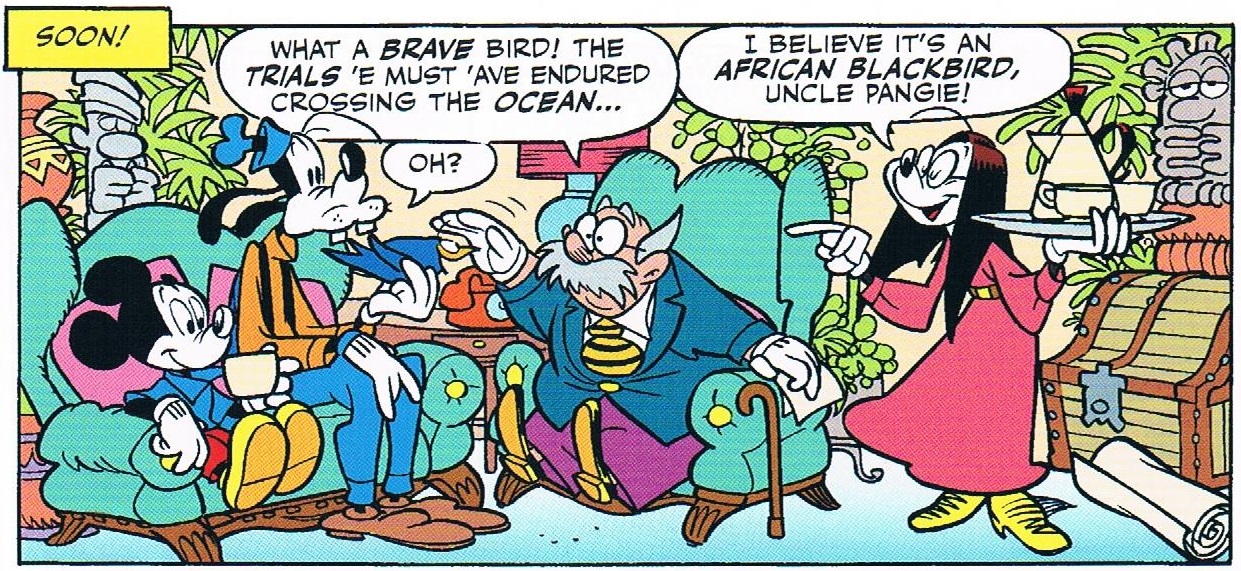
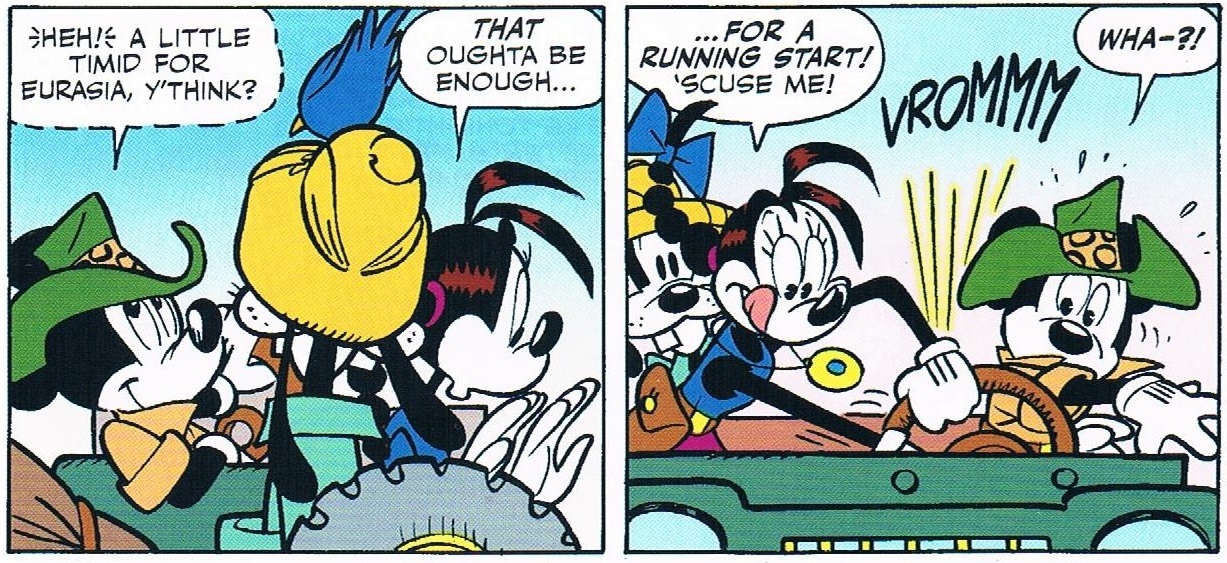
The real hero of “The Lost Explorers’ Trail” is Eurasia Toft. By all rights, it’s her story: it’s the pride, passion, and skill with which she takes up being the heir to her father’s legacy that drive the narrative. Mickey and Goofy are just along for the ride. Casty tacitly acknowledges this fact with M&G's very reason for accompanying Eurasia (they want to see how things turn out, as if they’re the reader), and how they become privy to the situation in the first place: a letter meant for Professor Toft is mistakenly delivered to Mickey’s address. It’s to Casty’s credit that I didn’t really notice this the first time through. Their enthusiasm for and earnest curiosity for the mission sells this case of tentative plot logic, which is then reinforced proactive initiative Mickey and Goofy take in a least getting through the adventure, even if they don't really have an impact on much of what happens. More often than not, Eurasia takes the lead...


...but Mickey and Goofy prove worthy partners in her adventure, weathering its perils just as well:


Arguably, Goofy is more extraneous than Mickey, but the opening “pancake contest” scene establishes a joined-at-the-hip “bosom buddies” camaraderie that continues to be exhibited throughout the story, distinguishing it from all those stories where Goofy is pretty much just there. I like Casty’s take on him here: while he’s aware of what’s going on and as and fully engaged as Mickey. See how they're equally at rapt attention here:


Or how Goof correctly notices something important BEFORE Mickey does:


But of course, when someone screws up, it's inevitably going to be Goofy... innocently enough:


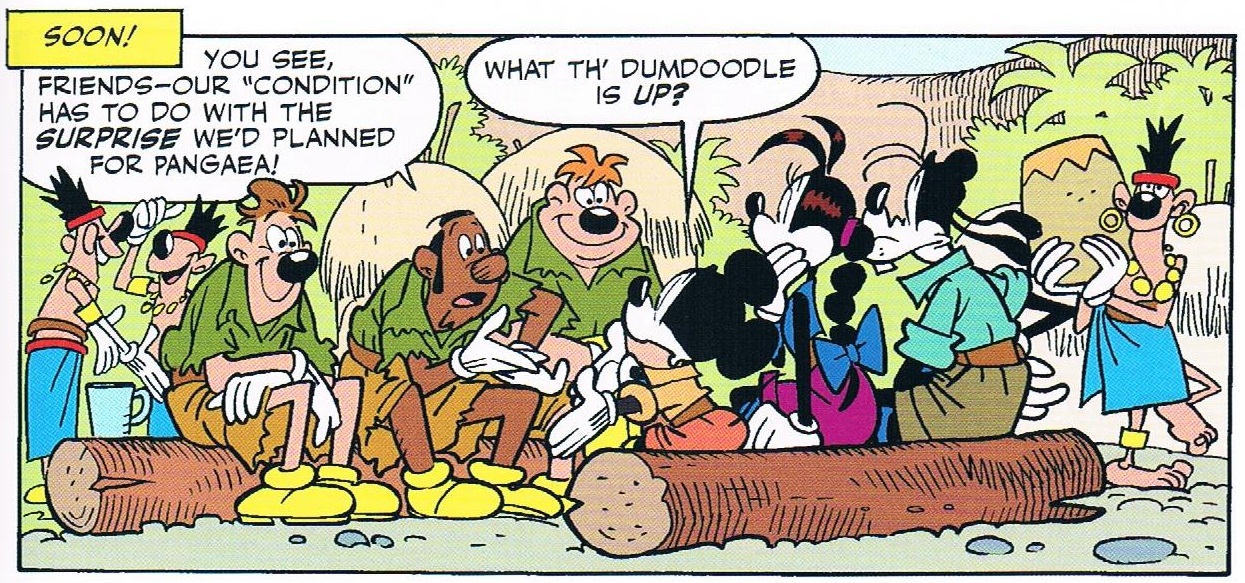
I’m not sure what to make of Eurasia, really. My knee-jerk reaction is that I’m not too keen on the employment the “nebbish librarian type who takes off her glasses and is suddenly an ass-kicking hot chick” cliché. (I’m taking it that her mom was a mouse, as her dad isn’t? Hey, I guess what proves that she’s a major character is that she has a Mickey/Minnie-style head, despite her taller height and creepy humanoid body.) In fact, all of the incidental characters in her orbit and the “part” each plays feel very familiar. There's her “jolly”, affable, intellectual, accomplished, now retired father, Pangea, who because of his pure, boundless love for his field, cannot truly forget the mystery he left unsolved and his missing friends. But he has great pride in his daughter, the bona fide apple-of-his-eye, and sees in her hope to finish what he couldn't. Then there's Pangea's equally spirited and insatiably curious adventure chums of academia. And finally, there's their corrupt, backstabbing, deceitful former peer. Even the way the secret valley’s biggest secret turns out to be able to cure Pangea's rheumatism, actually.  I’m not saying this familiarity is a bad thing – I’m just observing it. It’s worth noting, though, that when I lay all that out, it becomes apparent that this is more of a Eurasia Toft story than a Mickey Mouse story, eh? 

...look, they even KNOW it!


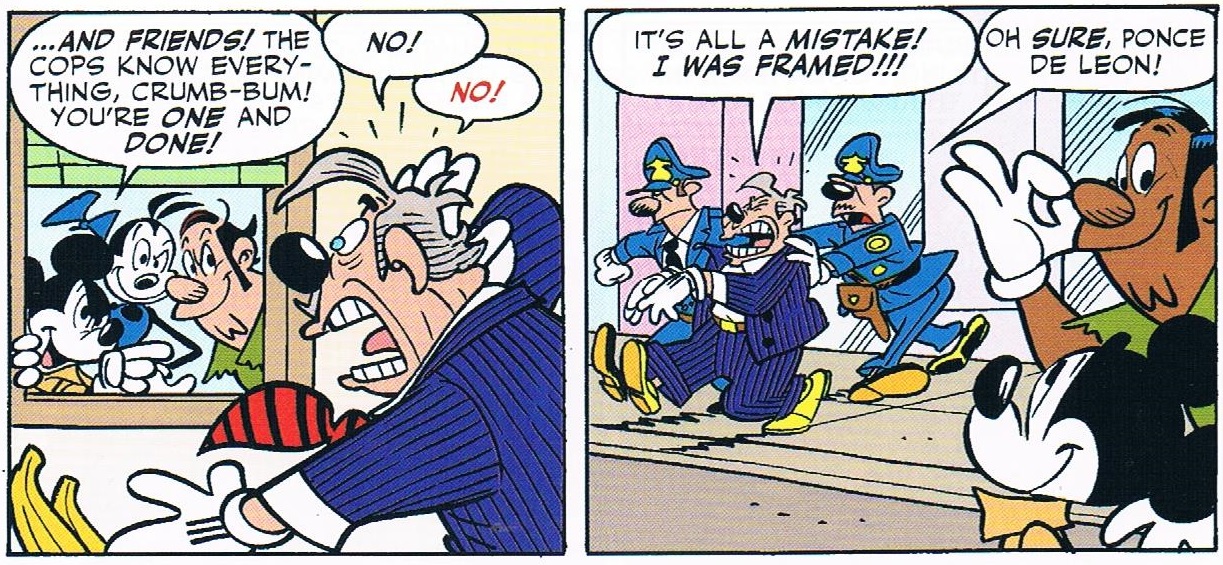
Regardless, it IS a Mickey Mouse story in that it was intended and produced as one, and, hey, having adventures is what Mickey does in comics, so the writers have to come up with reasons for him to have new ones, right? As archetypal as the new and/or incidental characters might be, Casty defines them with acute clarity and tells their story with airtight plotting. It struck me as unusually, almost realistically dark for a Disney comic how insidious the villain actually is, in having appeared to be an upstanding citizen but having actually left his friends for dead decades earlier. As fatal as most Disney comic villains’ intentions might be, the effects of their ill actions are usually attempted and thwarted in a linear span of time contained within one story.


As reflected in (in addition to the almost trans-Mickey plot and trans-Mickey cast) Cavazzano’s (literally) edgy, feisty, "zinging" art and the modern slang used by dialogue scribe Jonathan Gray, this is neither Gottfredson’s nor Murry’s Mickey, no. Nonetheless, it IS a modern incarnation of and in the Mickey Mouse adventure comic tradition that doesn’t betray the character or the genre. And that should be commended and celebrated.
_______________

And for those inclined, the Mickey Mouse comics tradition can be celebrated with this issue’s backup features: a quintessential Don Christensen-Paul Murry 1953 Pluto story (replete with narrative/commentary captions) and two Bill Walsh-Manuel Gonzalez Mickey Mouse Sundays featuring Ellsworth, including his very first appearance. I’ve written before of how from my limited exposure to the character, I wasn’t sure who or what he was ever even intended to be. But now, at last, I know Ellsworth for the smart-aleck prankster that he is. Kudos on your editorial choices, Mr. Gerstein. Ellsworth is now squarely established for further IDW appearances.


-- Ryan

New comic review: Donald Duck #2 (#369) (IDW, June 2015)

As it turns out, my prediction that “Shellfish Motives” Part Two would open with Donald and the nephews “being captured and thus having to work together” was completely wrong. And I couldn’t be happier, as Scarpa’s well-constructed, relatively complex, quasi-satirical* mystery story, while retaining the cloak-and-dagger flavor of the first installment, is much better than the action-adventure (with emphasis on the action) fare that I had envisioned.

* (I say "quasi-satirical" because, as with the social aspects of "The Duckburg 100", "Shellfish" is rife with political and diplomatic trappings which are played in a comical, spoofy way, but I wouldn't say that anything in particular is being targeted. I suppose, though, that a treatise could be written on what the Gourmandian professor's "going off the grid" maneuver says about the use of new science as leverage in high-level warring corpora-government combine power plays.)


If I would object to anything (and this is a tentative, not full-fledged objection), it would be the characterization of Donald as COMPLETELY clueless and wrongheaded, and the nephews so ENTIRELY superior to him in every respect. I like that Scarpa plays up the nephews’ resourcefulness and sharp wits, and while in essence it’s not out of character (to say the least) for Donald to be overconfident in his abilities and proceed with a task wrongheadedly, as in “Duckburg 100”, Scarpa presents a dumbed-down, practically infantile Donald. That said, Donald's attempted interviews with the different scientists (whose reactions vary from put off and annoyed to obvlious to Donald's presence) -- a string of encounters that's juxtaposed against the nephews staying on the right track in THEIR investigation -- are endearingly fun and funny, sort of with an (especially silly) Looney Tunes blackout gag flavor. Still, with Donald taking up Gideon on his job offer at the story's beginning, I felt that Donald was stepping across the threshold on a Hero's Journey... and yet after all is said and done, it seems that we're supposed to take the idea of him ever being a successful investigative reporter as a joke. It's safe to say that this is decidedly NOT a "mastery story".


From the parachute left in the taxicab down through the parsing out of the address where they find the professor, Scarpa’s plotting of the mystery-unraveling is admirable in its logic and its gradual, suspense-sustaining pacing. From the clues dropped throughout the story, I imagine that very few readers would ever discern “the full story” before all is told at the end – certain points (like the fact that the professor probably isn’t really also a chef) were suspected as highly likely, but would anyone have ever guessed that the professor already had his own candy in his pockets of the same type he was buying in the store? While the facts of the case when explained in full at the end are straightforward enough, the complexity is in how Scarpa, at first keeping this scenario near-completely concealed from the reader, lays down the narrative scheme in which the nephews, piece by piece, solve the case.


I had hoped that if the mysterious figure in Part One was indeed Scrooge -- as there there were telltale signs that it was -- then it would turn out that once we knew the whole deal, we would understand how and why we had been misled to believe that he was up to some villainy... and to my satisfaction, such exoneration panned out 100%. Naturally, the “full disclosure”, as relayed by the nephews, includes exposing Scrooge’s role, bringing him “on-screen”. What ensues nicely ties in a theme established at the beginning of the story: the rift between Scrooge and Gideon due to their opposing values and ambitions. I expressed in my review of Part One that I thought the character of Gideon and his relationship to Scrooge were good ideas, and seeing the fireworks that erupt when they actually interact really brings it home. (A familial divide so good, it’s almost like having another Donald-Gladstone rivalry.) Jonathan Gray’s dialogue in this sequence, which plays up that they’re both McDucks and have some fundamental similarities, fine-tunes and sharpens the McDuckian purity of this visceral exchange.


_______________

Closing out Donald #369 is a vintage treat, "Counter Spy", which at first glance, I figured was one of Al Taliaferro's gag-based "loose" continuities... but, nope, it was created exclusively for a 1947 Cheerios giveaway. Reformatted here for a standard-sized comic at three tiers per page, it comes out to (drumroll to build suspense) exactly 10 pages, a wildly appropriate number considering that the story consists of Donald waging suburban warfare against his next-door neighbor... in fact, against TWO next-door neighbors, the first of whom in fact is actually named (ahem) JONES, but unlike Barks' Jones, has a line in the sand for what he'll put up with and cares not to play into Donald's one-upmanship; the second of whom is eerily reminiscent of Barks' Herman the Hermit, and is just about as antisocial and curtly impolite, despite his actually bothering to take up residence in civilization.

Though the general proceedings and in particular the twist at the end that brings about Donald's comeuppance have Barksian shades, the crude characterization of Donald and the nephews (who seem to act pretty much as one here, which in itself is un-Barksian) -- first getting their jollies from harassing Taliaferro's "Jones", then invading his successor's life with their gossip-inclined nosiness and physical appearance-based suspiciousness -- aren't countered by any Barksian gravitas.


But let's take a step back. If how a non-Barksian Dell-era duck story measures up to Barks were the measure by which something's of interest or worthwhile, then virtually nothing would make the cut. On its own merits, this is a decently written and certainly well-drawn escapist, slapsticky funny animal comic quick read. So far, IDW's Disney comics have been dominated by European material. But turning a different leaf, this story's inclusion in Donald #369 follows in the tradition begun by Gladstone of select vintage/classic Golden Age/Dell-era American Disney comic reprints. Of course, Gladstone II gave us reprints of their own reprints of just a couple years earlier, as with "Back to the Klondike" and "Monarch of Medioka", amongst numerous examples, demonstrating what NOT to do. By contrast, this is the very first time "Counter Spy" has (at least per Inducks) has been reprinted in the U.S. since its original 1947 publication, exemplifying exactly what TO do.

-- Ryan