Showing posts with label Manuel Gonzalez. Show all posts

Thursday, December 10, 2015

Recent comic review: Walt Disney's Comics and Stories #722 (IDW, August 2015)


 Part 2 of "The Search for the Zodiac Stones" finds Mickey and and Goofy exactly where at the end of Part 1 they announced they were going next: Brazil. Goofy admiring a street vendor's display of local pottery and various other "souvenirs" while Mickey stands by, urging him, "Hey, we've got to get goin'!" may sound too casual for a splash panel opener, but Massimo De Vita's art is rife with so much activity, using arresting, dynamic perspectives and original, specific poses and expressions, it works fantastically.

Over the course of the next several pages, Mickey and Goofy meet Tex "Eagle-Eye" Tuckaree, a scatter-brained pilot they're chartering to fly them to the Stickaree village. The ensuing flight, culminating in a head-on crash smack-dab into the jungle, is as tumultuous as our heroes had feared, but to the reader, the sequence is entertainingly rife with first-rate quirky, comedic action. If "Eagle-Eye" (perhaps the best part of that name is not its intentional irony, but how Jonathan Grey's narration toys with said irony) reminds one of Launchpad McQuack, he should -- and indeed, Grey makes the allusion. (It would have almost been a crime not to.) In the flashback relating how Tex lost his eye-sight -- and, it would seem, his mind -- which thus ended his stunt pilot career, it's impossible not to think of Launchpad's backstory as having been one of the Flying McQuacks before he went solo.

The flashback ends with perhaps Grey's most priceless line of the issue (and there's a lot of good ones to choose from): "See how sad that story wasn't? Don't you feel awful for laughing?" In fact, put that way, I'm not sure how I can reconcile how charming, amusing, and fun I found the Tex Tuckaree sequence! However, I do feel vindicated in my having noted that it looks like there's going to be wacky, Rocky and Bullwinkle-esque aspects to this serial

Grey, a proven ace with references (one to a certain kaiju, and at least two in-jokes related to Mickey himself), wordplay ("blights, terrors, and terrored blights!"), and just plain colorful language ("Sweet babies!"; "THUNDERDUNK!"). But he exercises discretion and holds a delicate balance, playing it straight when called for -- notably at moments when plot logistics are established, such as the information the Stickarees share with Mickey and Goofy that allows them to pick up the trail they're following anew, or the news given to them by Cal and Cab about the sale of the Scorpio piece. But playing it straight doesn't necessarily mean playing it dry; as no-frills a line as Mickey's "They left with a canoe, so their trails can't be that cold!" might be, it certainly sounds like the scrappy Mickey we know. (Imagine if he'd said, "It appears that they have taken a canoe, which means that at this point, they cannot be very far ahead of us." Yuck!")

Visually and conceptually, the fantastical, even "trippy" Scorpion Valley sequence -- with its abundance of fumaroles ("baby volcanoes", per Goofy) spewing a gas that induces alarming ocular distortions character by scale wonkery -- is originally and intelligently conceived, especially considering the scientific explanation for -- and solution to -- how the illusions are chemically manifested. Mickey and Goofy going through the process of suffering the effects of the fumes and then figuring their way out of and overcoming this hallucinogenic trap follows a tight narrative arc that's near-perfect in its build-up and unraveling.

And finally -- what, you thought I actually wouldn't cover this -- there's the delightful surprise that comes right after Mickey and Goofy leave the Calloways' camp: their running into Scrooge, Donald, and the nephews, in the middle of one of their adventures, but one that's been going on without the reader being privy to it -- until the moment at which Mickey and Goofy join in! I knew that the ducks were going to be in this multi-part epic, but I wasn't expecting them in this installment. Thus, their reveal genuinely threw me for a loop, but in a very, very good way! Grey made it all the more sweet with his dialogue for the (highly personalized, descriptive) greetings exchanged between first Mickey and Donald, and in the next panel, Mickey and Scrooge.

Leading up to this chance meeting of major players, the reader was teased with the Stickarees' and Calloways' accounts of the "band of five" whose trail Mickey and Goofy are following.  Due to a loss in translation, Mickey suspects Pete and some of his known accomplices and sidekicks, whom Grey has Mickey name (or rather, has Mickey think, think, via thought balloon) as treat for the fans... that is, presuming these references are original to this version. I wonder how in the original version Mickey's elusive was described by the respective witnesses and what were Mickey's thought balloon speculations as to the identity of the group he's tailing.

This all-star team-up nearly eclipses the cliffhanger ending that follows. But let us not overlook yet another example of De Vita's talent -- using a heavily stylized, jagged style that imparts a throbbing jerkiness, the chaotic, violent energy of this geological upheaval almost rages out of the panel borders and off of the page.

One quibble: in Part 1, the Aquarius piece is referred to as Cab's. Here, it's Cal's, the Scorpio piece being cab's. A mistake that will be corrected in the trade, I presume?
________________

At a short but busy, expediently-but-evenly-paced four pages, Evan Geradts and Freddy Milton's "Open Door Policy" follows the Beagle Boys as they steal one of Gyro's latest (considerably more magical-seeming than usual!) inventions in order to use it to -- what else? -- rob the money bin. Being able to effortlessly make their own instant-entrance to the bin is virtually a Beagle's dream come true. There wouldn't be very much conflict if at first they didn't make off with some of the cash, but after some initial freaking out, Scrooge ultimately manages to thwart, in a wildly ironic, perfectly fitting way. This resolution -- like the rest of the story -- plays out with "wham, bang, done" pacing that conveys the Beagles' fated comeuppance in a particularly lucid, stinging way. Maura McManus' dialogue is modest but witty (and in-character), suiting the story quite nicely. E.g., the descriptive, silly names for several of Gyro's silly invention; or the last line of the story, Scrooge, gloating to the Beagles over his foiling them, making a "door pun" that's grin-inducing in a "Oh, you just HAD to, didn't you?" way.
________________

Two gag pieces -- one duck, one mouse -- fill out the issue. In Al Taliaferro's "Demolition Donkey", a sportswear salesman is left baffled by Donald without explanation returning one sport's uniform amd exchanging it for that of a completely, drastically different sport.

Though Mickey behaves uncharacteristically childish in Merrill De Maris and Manuel Gonzalez's 1939 Sunday "Minnie Can't See", it definitely makes sense that the robust, active, outgoing Mickey of the strips -- as established by Gottfredson -- would be too restless to spend a day at the beach just loafing, as Minnie expects him of him. Here, she's prissy and preoccupied with social acceptance (a characterization more often used for Daisy, but not without precedent for Minnie). After seeing her act snippy and condescending toward Mickey, one's spite is rewarded (Mickey clearly enjoys it, too! by her obliviousness in the last couple panels that she herself is the object of the crowd's mocking laughter.

-- Ryan

Tuesday, October 13, 2015

New comic review: Mickey Mouse #312 (IDW, August 2015)

Mickey Mouse #312 marks the first occasion of IDW continuing the tradition begun by Gladstone and continued in succession by Disney Comics (primarily post-Implosion), Gemstone, and the pre-IDW licensee: presenting as the lead feature in an issue of an ongoing comic book title a reprint of a classic American Disney comic book story that had originally appeared in an issue of another (or sometimes the same) ongoing comic book title. (Yes, Western was reprint-heavy from the '60's through the '80's, but it was Gladstone that really made celebrated, contextualized reprints a regular thing.) I've appreciated as much as anyone how to date IDW's Disney line has been dominated by so much material brand-new to these shores, but I'm glad and grateful that a place has been made for also upholding this tradition (which in American comics, is a unique purview of ours, the only major exception that I can think of being DC's late-Silver-and-Bronze-Age "100-Page Spectacular" special issues).

Jonathan Gray's rich, explosive "
Mysterious Crystal Ball"-based
cover for Mickey Mouse #312

Though even many of the more adventure-oriented (whether they take place on locomotives, or in the desert or jungle) Paul Murry-drawn Mickey serials from WDC&S can be classified in the procedural genre, as the plots almost always involve Mickey unraveling a mystery and in the end nabbing the "common criminal" crooks/swindlers behind it, "The Mysterious Crystal Ball" is overtly a police/detective procedural. What distinguishes it is its magic and supernatural themes, although true to these stories', errr, grounded nature, all of the magic and supernatural-ness is a hoax perpetrated by the story's villains, who are... "common criminal" crook/swindlers. If anything, the villains' convoluted and tedious-to-execute but bare-bones scheme and methods for deceiving and diverting Mickey and the police from a plain ol' bank robbery, errr, elegant in their simplicity. The narrative is almost definitively straightforward, textbook, patchwork crime-detective genre fare -- if only the real world's crimes and the solving and stopping of them were so neat-and-tidy and cut-and-dry! ...that is, once the villains' plan is laid bare.

(Really, for one night, the entirety of the Mouseton PD's manpower was invested in these thugs' shenanigans! Bless their hearts that this was as bad as things got in the Murry-drawn Mouseton, and that they weren't cynical enough to think to contrive a search warrant for the swami's tent to nip the whole thing in the bud!) In fact, the only thing that make the whole operation remotely elaborate is the live broadcasts -- twenty years later, they could have just pre-taped all of it with a home video camera! (Actually, since they had the ability to play films in the crystal ball, given the zoo instance, why didn't they just film everything?)

Still, a fair degree of story craft is evident, given that up until the scene in which the plan was explained, it wasn't apparent (at least to me) what exactly they were up to. It's just that, as can be generally said of most of Western's Mickey Mouse stories, the storytelling is dry and not very dynamic. But as a fan, I enjoy and appreciate them, "Mysterious Crystal Ball" included, in their place and for what they are.

I enjoyed the antics of "Shamrock Bones from WDC 164". As a comic relief-oriented peripheral active doppelganger to Mickey for the duration of a case, he actually reminded me of Casey in "Mickey Mouse Outwits the Phantom Blot"... except that Bones actually had a hand in the case's success

I can't help but comment on a note Inducks made on this reprint: "Detective's gun replaced by truncheon on page 6" (of Part Three). Really? It's not okay for one of the good guys to shoot back at the bad guys? Even when he's working with the police, if not police himself?

[Update: I mistakenly had in mind a panel other than the one that Inducks was referring to. In the panel that they actually WERE referring to, Bones was actually shooting at the bad guys as they fled, not "shooting back" at anyone, so my criticism was erroneous. See 1.) Hex's comment below on the changes made to the story for Mickey #312, and especially see 2.) his detailed post at his own blog exhibiting side-by-side comparisons of the original and this reprint. He mentions and links to said post below, and I'm also link to it here.]
_______________

As a string of gags (eighteen days' worth, in fact), I wouldn't consider Colette Bezzio and Rick Hoover's "Ecks and Doublex Reform" (from the Mickey Mouse syndicated newspaper strip, 1994-95, and teased in Vol. 2 of Fantagraphics' Gottfredson collection) to be a full-fledged sequel to the truly classic "Blaggard Castle", but the manic, kooky behavior of the professors (both reformed and un-reformed) is spot-on. Kudos, Colette and Rick!

"The 'Lawn'atic", this issue's ancient British relic (1938, actually) features an atypically neurotic Goofy, but I actually really liked this gag, which is perhaps the closest I've ever seen a Disney comic come to Curb Your Enthusiasm. Surprising, considering its age! But I guess that's because "[a] strong theme of sarcasm and self-deprecation, often with deadpan delivery, runs throughout British humour."

And lest I forget there's two more Walsh-Gonzalez Mickey Mouse Sundays (from '50 and '53, respectively) featuring Ellsworth. In he first, Mickey leaves the roughneck, sarcastic mynah in Goofy's care, and in the second, Horace's. Ellsworth causes upheaval in both residences, with Horace decidedly finding it more grating. Both strips are as unpredictable, rowdy, original, and clever as Ellsworth himself is.

-- Ryan

Monday, August 31, 2015

New comic review: Mickey Mouse #311 (IDW, July 2015)

When a few months ago I first saw Dave Alvarez' delicious, delectable cover prominently displaying the Phantom Blot in all his glory, Mickey Mouse #311 immediately became one of my most eagerly anticipated of the issues of IDW's first summer of Disney.


For a 33-page story, which is on the long side by Disney comics standards, it's surprising how little of a plot there is to it: the primary conflict is Mickey's altered (in fact, enhanced, but in a way that often seems more like a hindrance) hearing. Though his condition is caused at the story's beginning during a scuffle with the Blot, it's by complete accident, not at all intended by the "black-cloaked blaggard". (Kudos, Torcivia!) Later, the Blot takes advantage of the situation, making things hairier for Mickey... but by not showing what the Blot is doing and how, and the ambiguity about whether or not any of it is in fact the Blot's doing, holding off on the big reveal -- via a gloating Blot soliloquy that precipitates the hero and villain's final showdown -- makes the story read confusingly and disjointedly. The specs of said soliloquy of revelation illustrate a scheme contrived and cobbled together on a "winging it" level never before attained (or stooped down to?) by the Blot. There's so little to it, the story doesn't even ever build to that much of a climax; Mickey just all of the sudden puts everything together and we make a clean break in cutting right to the aforementioned final showdown. The way that Mickey surprises the Blot by nonchalantly strutting into his hideout as he delivers his aforementioned soliloquy is funny, but Mickey's explanation as to how he seemingly magically found the hideout is another one of the story's forced, head-scratching-inducing shortcuts that you kind of have to just put out of mind to go on reading.

All that said, I actually like the story(!) After all, hey, it's the Phantom Blot! Thanks in large part to Cavazzano, the story is a whole lot of fun, with the hyperactivity of his art engendering a bold, sweeping dynamics and the illusion of rapid pacing. Also, I'm getting to really like Cavazzano's Mickey, drawn with certain quirks and details that make him one of the most attractive pupil-eyed Mickeys I've ever seen. The deftness of Cavazzano's dazzling dynamics especially enhance the bookend pair of Mickey-Blot slug-fests, which are presented as archetypal confrontations between our staunch detective hero and his most formidable arch-nemesis. The laboratory setting of the first battle and especially the clock tower setting of the one at the climax take things over the top aesthetically, really playing up the whole arch-villain thing. I've taken issue in the past with how all non-Gottfredson takes on the Blot have forgotten that he was a foreign spy with a very specific mission and cast him as an all-purpose super-villain, but as I'm several decades too late with that complaint, showing him without the hood through the whole story and playing up his penchant for disguises (besides his usual one, that is) and for building things (it's not just death traps anymore!) is a good consolation prize. Torcivia's several references to the death traps sweeten the deal, too. 

Like the original Blot story, this one is heavy on Mickey working with Chief O'Hara, much to the (though he won't admit it) envy of Detective Casey, story choices that to me go a long way in creating the "feel" of a Phantom Blot story. Casey's reassignment to traffic cop is a legitimately funny new spin on his comic relief role in the original, where, repeatedly, his bravado only made the embarrassment of his bungling all the worse. Casey's hooting and hollering over Mickey and the Blot's brawl brought to mind Sgt. Bullock's emphatic ravings as he witnessed Azrael-as-Batman take down Bane in the "Knightfall" story line. This brought me a certain satisfaction, as I've always considered that as Bullock is to Gordon, Casey is to O'Hara, and I've always considered Gottfredson's original Blot story the closest a Mickey Mouse story ever got to being a Batman story.

With these characterizations (the Blot, O'Hara, Casey) and with the emphasis on Mickey's friendships with "the ol' gang", writer Bruno Enna plays into and with the audience's familiarity with the respective cast, playing a fresh, new variation of an old song, so to speak. Though the Mickey denunciations that Mickey himself overhears -- that are in fact faked by the Blot -- have the story for a few seconds approaching (sort of inverted) It's a Wonderful Life territory, the "quintessential" characterizations give the story a sort of This Is Your Life "tour" feel akin to "A Little Something Special" (but although "Sound-Blot Plot" is special, it's not quite that special). In the plot's casual coincidences and the atypical story momentum that comes from Mickey just trying to have a normal day, except weird things are happening to him, and as they appear incidental rather than the result of a scheme or (if you will) plot (in fact, they are in part incidental),, for a good while there's no particular goal or objective driving the narrative; it reflects Mickey's confusion, and that's not bad writing; it's wildly appropriate. There's actually a certain kind of quasi-realism (kind of like with "The Duckburg 100", now that I think of it), with Mickey and his pals feeling like they have one or two more added dimensions just because we see them in something (weirdly) resembling "real time".

Goofy's sweetness was a nice touch, and his harmless but eccentric "hoarder"-esque habits was a fresh take. (In fact, with his bird fostering and silent, mimed communication that he prolongs much longer than Mickey needed, he actually comes off as lighter version of Charlie from It's Always Sunny in Philadelphia!) His intervention at the climax was perfectly timed, as well as both funny and touching.

Once again, the backup features satisfy one's "classic rarities" needs: another Walsh-Gonzalez Sunday featuring Ellsworth, and a crude but historically interesting British gag from the early '30's(!) in which Mickey performs physical comedy that back in the States, via Gottfredson, he was already well evolved beyond (for which I'm grateful).

-- Ryan

Thursday, July 30, 2015

New comic review: Mickey Mouse #1 (#310) (IDW, June 2015)

I didn’t realize that Casty had started only writing and not drawing some of his stories. Is that for scheduling reasons? Or because as he envisioned this story, it was in Cavazzano’s style? And either way, does it mean that a story he doesn’t both write and draw isn’t as much his baby?

However, he did draw the cover:


With the ducks, especially with Scrooge’s treasure-hunting inclinations, there’s usually a logical reason related to the innate nature of their character(s) that they wind up on the adventures that they do. Even with Donald’s everyman nature, the plot m.o. can be his drive to prove himself. That’s not to say that even Barks didn’t contrive reasons why Donald and the nephews, sans Scrooge, would find themselves in life-threatening predicaments on the other side of the world. But it’s really Mickey, not Donald, with whom more than once, I’ve stopped and wondered, “Hey, just HOW has he had all those adventures, anyway?” (In the stories in which he’s not acting in his quasi-established role of a private investigator. Actually, I’m not even sure if he considers himself one, or if he just is always helping Chief O’Hara out as a friend.)


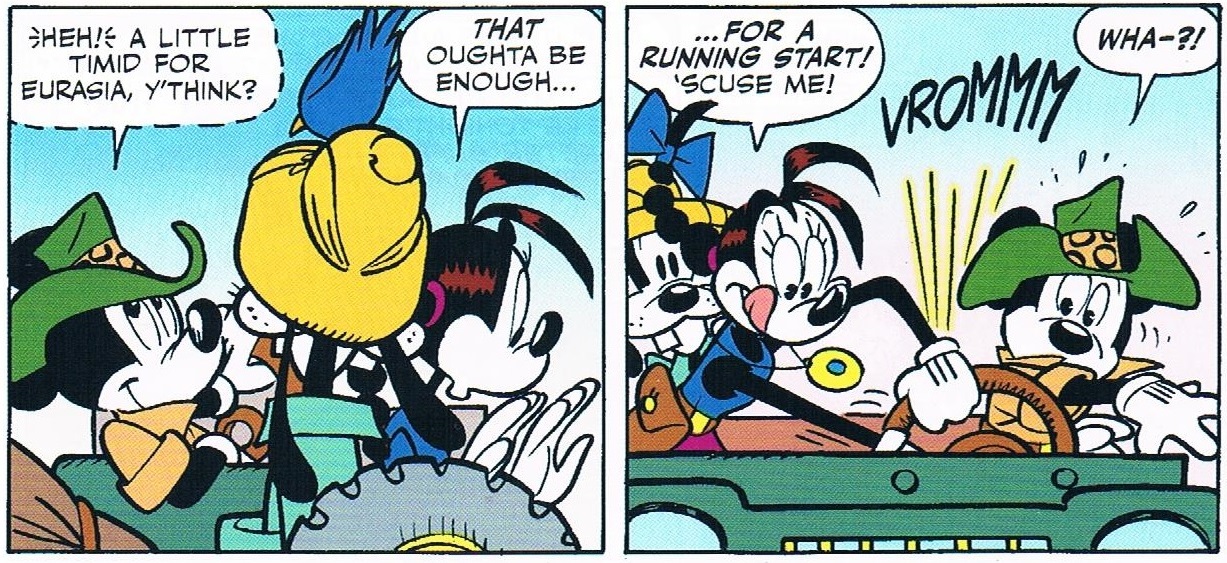
The real hero of “The Lost Explorers’ Trail” is Eurasia Toft. By all rights, it’s her story: it’s the pride, passion, and skill with which she takes up being the heir to her father’s legacy that drive the narrative. Mickey and Goofy are just along for the ride. Casty tacitly acknowledges this fact with M&G's very reason for accompanying Eurasia (they want to see how things turn out, as if they’re the reader), and how they become privy to the situation in the first place: a letter meant for Professor Toft is mistakenly delivered to Mickey’s address. It’s to Casty’s credit that I didn’t really notice this the first time through. Their enthusiasm for and earnest curiosity for the mission sells this case of tentative plot logic, which is then reinforced proactive initiative Mickey and Goofy take in a least getting through the adventure, even if they don't really have an impact on much of what happens. More often than not, Eurasia takes the lead...


...but Mickey and Goofy prove worthy partners in her adventure, weathering its perils just as well:


Arguably, Goofy is more extraneous than Mickey, but the opening “pancake contest” scene establishes a joined-at-the-hip “bosom buddies” camaraderie that continues to be exhibited throughout the story, distinguishing it from all those stories where Goofy is pretty much just there. I like Casty’s take on him here: while he’s aware of what’s going on and as and fully engaged as Mickey. See how they're equally at rapt attention here:


Or how Goof correctly notices something important BEFORE Mickey does:


But of course, when someone screws up, it's inevitably going to be Goofy... innocently enough:


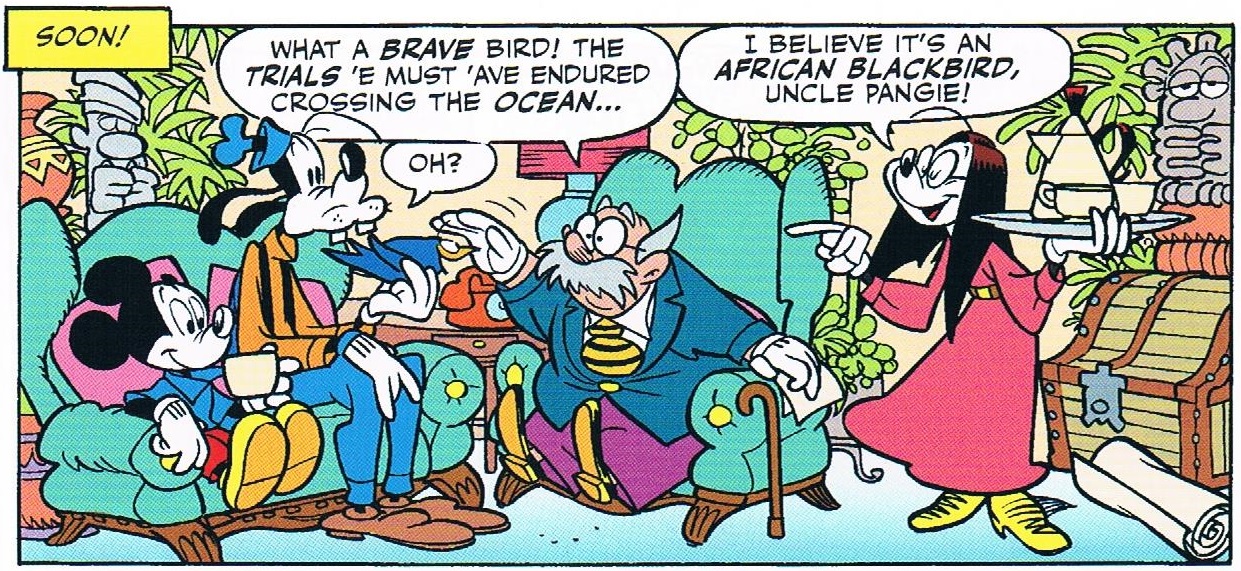
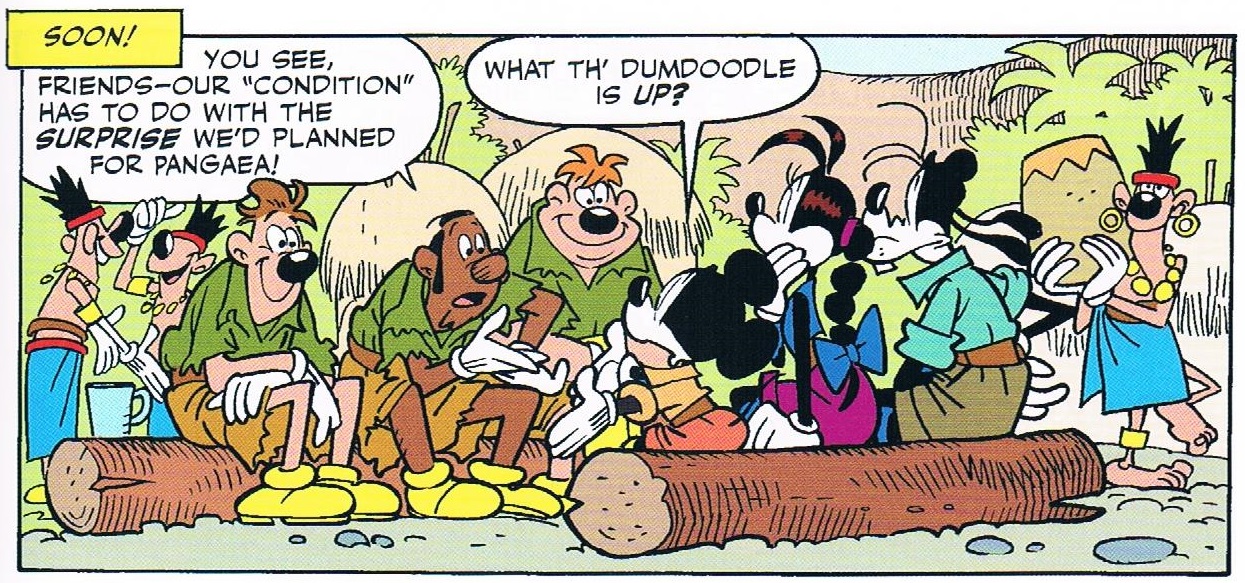
I’m not sure what to make of Eurasia, really. My knee-jerk reaction is that I’m not too keen on the employment the “nebbish librarian type who takes off her glasses and is suddenly an ass-kicking hot chick” cliché. (I’m taking it that her mom was a mouse, as her dad isn’t? Hey, I guess what proves that she’s a major character is that she has a Mickey/Minnie-style head, despite her taller height and creepy humanoid body.) In fact, all of the incidental characters in her orbit and the “part” each plays feel very familiar. There's her “jolly”, affable, intellectual, accomplished, now retired father, Pangea, who because of his pure, boundless love for his field, cannot truly forget the mystery he left unsolved and his missing friends. But he has great pride in his daughter, the bona fide apple-of-his-eye, and sees in her hope to finish what he couldn't. Then there's Pangea's equally spirited and insatiably curious adventure chums of academia. And finally, there's their corrupt, backstabbing, deceitful former peer. Even the way the secret valley’s biggest secret turns out to be able to cure Pangea's rheumatism, actually.  I’m not saying this familiarity is a bad thing – I’m just observing it. It’s worth noting, though, that when I lay all that out, it becomes apparent that this is more of a Eurasia Toft story than a Mickey Mouse story, eh? 

...look, they even KNOW it!


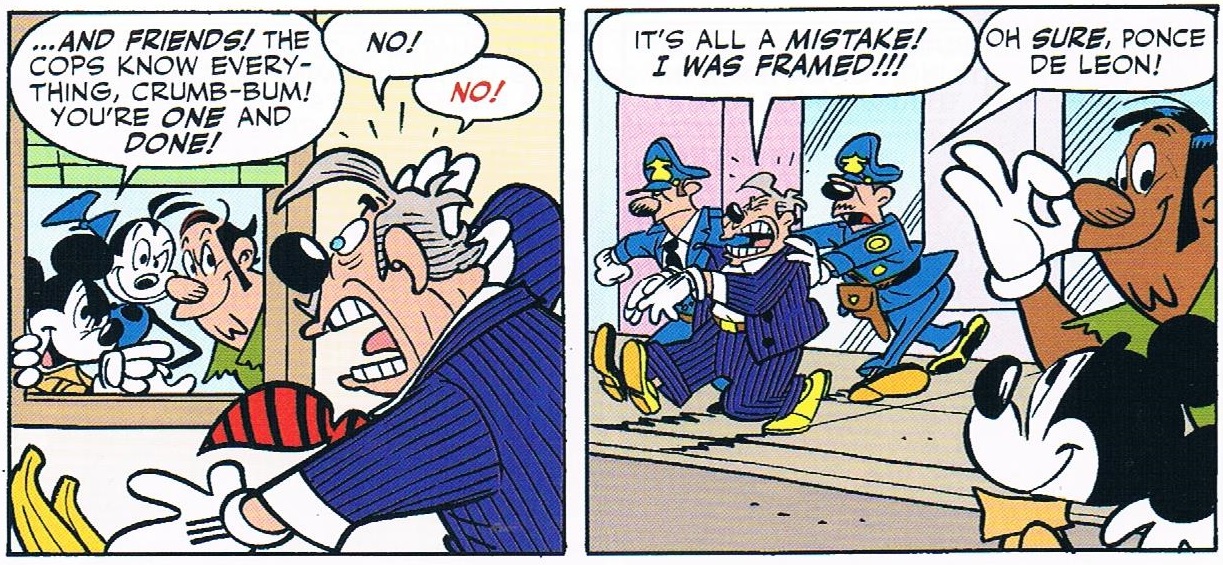
Regardless, it IS a Mickey Mouse story in that it was intended and produced as one, and, hey, having adventures is what Mickey does in comics, so the writers have to come up with reasons for him to have new ones, right? As archetypal as the new and/or incidental characters might be, Casty defines them with acute clarity and tells their story with airtight plotting. It struck me as unusually, almost realistically dark for a Disney comic how insidious the villain actually is, in having appeared to be an upstanding citizen but having actually left his friends for dead decades earlier. As fatal as most Disney comic villains’ intentions might be, the effects of their ill actions are usually attempted and thwarted in a linear span of time contained within one story.


As reflected in (in addition to the almost trans-Mickey plot and trans-Mickey cast) Cavazzano’s (literally) edgy, feisty, "zinging" art and the modern slang used by dialogue scribe Jonathan Gray, this is neither Gottfredson’s nor Murry’s Mickey, no. Nonetheless, it IS a modern incarnation of and in the Mickey Mouse adventure comic tradition that doesn’t betray the character or the genre. And that should be commended and celebrated.
_______________

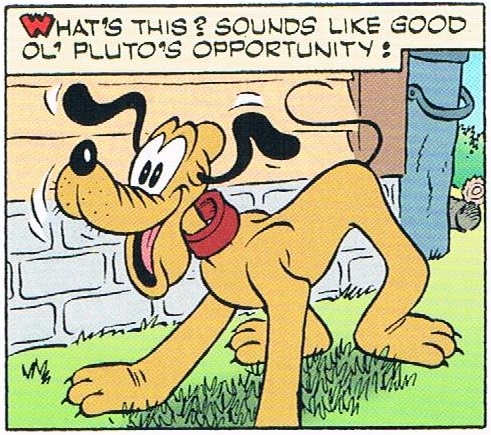
And for those inclined, the Mickey Mouse comics tradition can be celebrated with this issue’s backup features: a quintessential Don Christensen-Paul Murry 1953 Pluto story (replete with narrative/commentary captions) and two Bill Walsh-Manuel Gonzalez Mickey Mouse Sundays featuring Ellsworth, including his very first appearance. I’ve written before of how from my limited exposure to the character, I wasn’t sure who or what he was ever even intended to be. But now, at last, I know Ellsworth for the smart-aleck prankster that he is. Kudos on your editorial choices, Mr. Gerstein. Ellsworth is now squarely established for further IDW appearances.


-- Ryan