Jonathan Gray's rich, explosive "
Mysterious Crystal Ball"-based
cover for Mickey Mouse #312
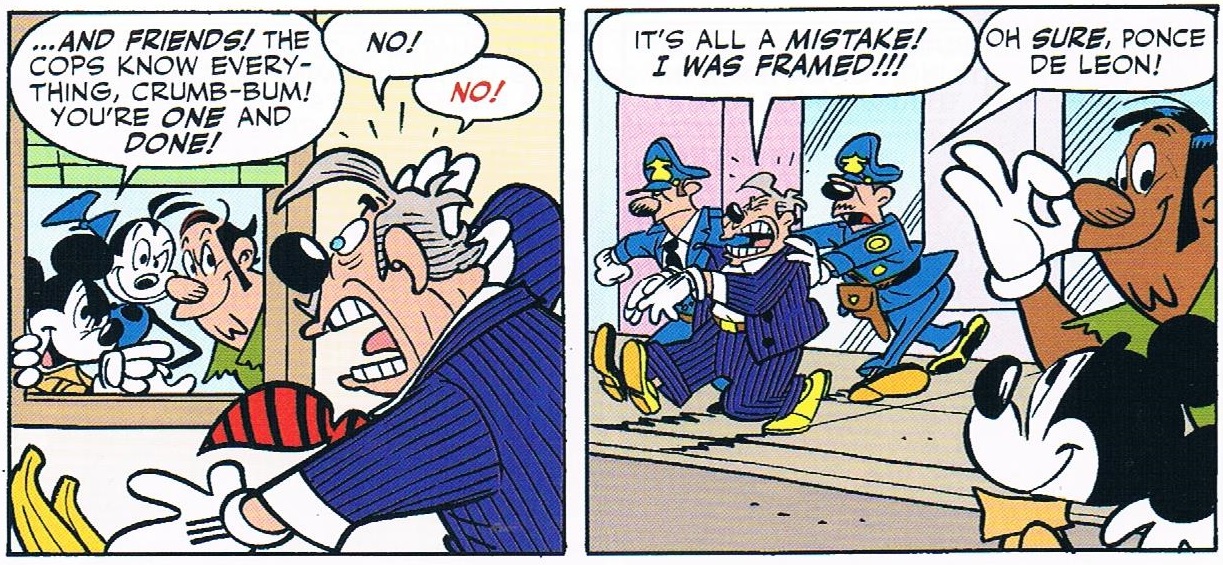
Though even many of the more adventure-oriented (whether they take place on locomotives, or in the desert or jungle) Paul Murry-drawn Mickey serials from WDC&S can be classified in the procedural genre, as the plots almost always involve Mickey unraveling a mystery and in the end nabbing the "common criminal" crooks/swindlers behind it, "The Mysterious Crystal Ball" is overtly a police/detective procedural. What distinguishes it is its magic and supernatural themes, although true to these stories', errr, grounded nature, all of the magic and supernatural-ness is a hoax perpetrated by the story's villains, who are... "common criminal" crook/swindlers. If anything, the villains' convoluted and tedious-to-execute but bare-bones scheme and methods for deceiving and diverting Mickey and the police from a plain ol' bank robbery, errr, elegant in their simplicity. The narrative is almost definitively straightforward, textbook, patchwork crime-detective genre fare -- if only the real world's crimes and the solving and stopping of them were so neat-and-tidy and cut-and-dry! ...that is, once the villains' plan is laid bare.
(Really, for one night, the entirety of the Mouseton PD's manpower was invested in these thugs' shenanigans! Bless their hearts that this was as bad as things got in the Murry-drawn Mouseton, and that they weren't cynical enough to think to contrive a search warrant for the swami's tent to nip the whole thing in the bud!) In fact, the only thing that make the whole operation remotely elaborate is the live broadcasts -- twenty years later, they could have just pre-taped all of it with a home video camera! (Actually, since they had the ability to play films in the crystal ball, given the zoo instance, why didn't they just film everything?)
Still, a fair degree of story craft is evident, given that up until the scene in which the plan was explained, it wasn't apparent (at least to me) what exactly they were up to. It's just that, as can be generally said of most of Western's Mickey Mouse stories, the storytelling is dry and not very dynamic. But as a fan, I enjoy and appreciate them, "Mysterious Crystal Ball" included, in their place and for what they are.
I enjoyed the antics of "Shamrock Bones from WDC 164". As a comic relief-oriented peripheral active doppelganger to Mickey for the duration of a case, he actually reminded me of Casey in "Mickey Mouse Outwits the Phantom Blot"... except that Bones actually had a hand in the case's success
I can't help but comment on a note Inducks made on this reprint: "Detective's gun replaced by truncheon on page 6" (of Part Three). Really? It's not okay for one of the good guys to shoot back at the bad guys? Even when he's working with the police, if not police himself?
[Update: I mistakenly had in mind a panel other than the one that Inducks was referring to. In the panel that they actually WERE referring to, Bones was actually shooting at the bad guys as they fled, not "shooting back" at anyone, so my criticism was erroneous. See 1.) Hex's comment below on the changes made to the story for Mickey #312, and especially see 2.) his detailed post at his own blog exhibiting side-by-side comparisons of the original and this reprint. He mentions and links to said post below, and I'm also link to it here.]
_______________
As a string of gags (eighteen days' worth, in fact), I wouldn't consider Colette Bezzio and Rick Hoover's "Ecks and Doublex Reform" (from the Mickey Mouse syndicated newspaper strip, 1994-95, and teased in Vol. 2 of Fantagraphics' Gottfredson collection) to be a full-fledged sequel to the truly classic "Blaggard Castle", but the manic, kooky behavior of the professors (both reformed and un-reformed) is spot-on. Kudos, Colette and Rick!
"The 'Lawn'atic", this issue's ancient British relic (1938, actually) features an atypically neurotic Goofy, but I actually really liked this gag, which is perhaps the closest I've ever seen a Disney comic come to Curb Your Enthusiasm. Surprising, considering its age! But I guess that's because "[a] strong theme of sarcasm and self-deprecation, often with deadpan delivery, runs throughout British humour."
And lest I forget there's two more Walsh-Gonzalez Mickey Mouse Sundays (from '50 and '53, respectively) featuring Ellsworth. In he first, Mickey leaves the roughneck, sarcastic mynah in Goofy's care, and in the second, Horace's. Ellsworth causes upheaval in both residences, with Horace decidedly finding it more grating. Both strips are as unpredictable, rowdy, original, and clever as Ellsworth himself is.
-- Ryan