Showing posts with label Giorgio Cavazanno. Show all posts

Thursday, December 10, 2015

Recent comic review: Walt Disney's Comics and Stories #722 (IDW, August 2015)


 Part 2 of "The Search for the Zodiac Stones" finds Mickey and and Goofy exactly where at the end of Part 1 they announced they were going next: Brazil. Goofy admiring a street vendor's display of local pottery and various other "souvenirs" while Mickey stands by, urging him, "Hey, we've got to get goin'!" may sound too casual for a splash panel opener, but Massimo De Vita's art is rife with so much activity, using arresting, dynamic perspectives and original, specific poses and expressions, it works fantastically.

Over the course of the next several pages, Mickey and Goofy meet Tex "Eagle-Eye" Tuckaree, a scatter-brained pilot they're chartering to fly them to the Stickaree village. The ensuing flight, culminating in a head-on crash smack-dab into the jungle, is as tumultuous as our heroes had feared, but to the reader, the sequence is entertainingly rife with first-rate quirky, comedic action. If "Eagle-Eye" (perhaps the best part of that name is not its intentional irony, but how Jonathan Grey's narration toys with said irony) reminds one of Launchpad McQuack, he should -- and indeed, Grey makes the allusion. (It would have almost been a crime not to.) In the flashback relating how Tex lost his eye-sight -- and, it would seem, his mind -- which thus ended his stunt pilot career, it's impossible not to think of Launchpad's backstory as having been one of the Flying McQuacks before he went solo.

The flashback ends with perhaps Grey's most priceless line of the issue (and there's a lot of good ones to choose from): "See how sad that story wasn't? Don't you feel awful for laughing?" In fact, put that way, I'm not sure how I can reconcile how charming, amusing, and fun I found the Tex Tuckaree sequence! However, I do feel vindicated in my having noted that it looks like there's going to be wacky, Rocky and Bullwinkle-esque aspects to this serial

Grey, a proven ace with references (one to a certain kaiju, and at least two in-jokes related to Mickey himself), wordplay ("blights, terrors, and terrored blights!"), and just plain colorful language ("Sweet babies!"; "THUNDERDUNK!"). But he exercises discretion and holds a delicate balance, playing it straight when called for -- notably at moments when plot logistics are established, such as the information the Stickarees share with Mickey and Goofy that allows them to pick up the trail they're following anew, or the news given to them by Cal and Cab about the sale of the Scorpio piece. But playing it straight doesn't necessarily mean playing it dry; as no-frills a line as Mickey's "They left with a canoe, so their trails can't be that cold!" might be, it certainly sounds like the scrappy Mickey we know. (Imagine if he'd said, "It appears that they have taken a canoe, which means that at this point, they cannot be very far ahead of us." Yuck!")

Visually and conceptually, the fantastical, even "trippy" Scorpion Valley sequence -- with its abundance of fumaroles ("baby volcanoes", per Goofy) spewing a gas that induces alarming ocular distortions character by scale wonkery -- is originally and intelligently conceived, especially considering the scientific explanation for -- and solution to -- how the illusions are chemically manifested. Mickey and Goofy going through the process of suffering the effects of the fumes and then figuring their way out of and overcoming this hallucinogenic trap follows a tight narrative arc that's near-perfect in its build-up and unraveling.

And finally -- what, you thought I actually wouldn't cover this -- there's the delightful surprise that comes right after Mickey and Goofy leave the Calloways' camp: their running into Scrooge, Donald, and the nephews, in the middle of one of their adventures, but one that's been going on without the reader being privy to it -- until the moment at which Mickey and Goofy join in! I knew that the ducks were going to be in this multi-part epic, but I wasn't expecting them in this installment. Thus, their reveal genuinely threw me for a loop, but in a very, very good way! Grey made it all the more sweet with his dialogue for the (highly personalized, descriptive) greetings exchanged between first Mickey and Donald, and in the next panel, Mickey and Scrooge.

Leading up to this chance meeting of major players, the reader was teased with the Stickarees' and Calloways' accounts of the "band of five" whose trail Mickey and Goofy are following.  Due to a loss in translation, Mickey suspects Pete and some of his known accomplices and sidekicks, whom Grey has Mickey name (or rather, has Mickey think, think, via thought balloon) as treat for the fans... that is, presuming these references are original to this version. I wonder how in the original version Mickey's elusive was described by the respective witnesses and what were Mickey's thought balloon speculations as to the identity of the group he's tailing.

This all-star team-up nearly eclipses the cliffhanger ending that follows. But let us not overlook yet another example of De Vita's talent -- using a heavily stylized, jagged style that imparts a throbbing jerkiness, the chaotic, violent energy of this geological upheaval almost rages out of the panel borders and off of the page.

One quibble: in Part 1, the Aquarius piece is referred to as Cab's. Here, it's Cal's, the Scorpio piece being cab's. A mistake that will be corrected in the trade, I presume?
________________

At a short but busy, expediently-but-evenly-paced four pages, Evan Geradts and Freddy Milton's "Open Door Policy" follows the Beagle Boys as they steal one of Gyro's latest (considerably more magical-seeming than usual!) inventions in order to use it to -- what else? -- rob the money bin. Being able to effortlessly make their own instant-entrance to the bin is virtually a Beagle's dream come true. There wouldn't be very much conflict if at first they didn't make off with some of the cash, but after some initial freaking out, Scrooge ultimately manages to thwart, in a wildly ironic, perfectly fitting way. This resolution -- like the rest of the story -- plays out with "wham, bang, done" pacing that conveys the Beagles' fated comeuppance in a particularly lucid, stinging way. Maura McManus' dialogue is modest but witty (and in-character), suiting the story quite nicely. E.g., the descriptive, silly names for several of Gyro's silly invention; or the last line of the story, Scrooge, gloating to the Beagles over his foiling them, making a "door pun" that's grin-inducing in a "Oh, you just HAD to, didn't you?" way.
________________

Two gag pieces -- one duck, one mouse -- fill out the issue. In Al Taliaferro's "Demolition Donkey", a sportswear salesman is left baffled by Donald without explanation returning one sport's uniform amd exchanging it for that of a completely, drastically different sport.

Though Mickey behaves uncharacteristically childish in Merrill De Maris and Manuel Gonzalez's 1939 Sunday "Minnie Can't See", it definitely makes sense that the robust, active, outgoing Mickey of the strips -- as established by Gottfredson -- would be too restless to spend a day at the beach just loafing, as Minnie expects him of him. Here, she's prissy and preoccupied with social acceptance (a characterization more often used for Daisy, but not without precedent for Minnie). After seeing her act snippy and condescending toward Mickey, one's spite is rewarded (Mickey clearly enjoys it, too! by her obliviousness in the last couple panels that she herself is the object of the crowd's mocking laughter.

-- Ryan

Monday, September 21, 2015

New comic review: Donald Duck #370 (IDW, July 2015)

"The Siege of Nothing Atoll" (this titular pun I'm assuming is the work of Thad Komorowski, the story's English dialogue scribe [Edit: It's not Thad's! See his comment below.]), dating from 1976, is much earlier than most of the Cavazzano-drawn stories that we've seen lately, only a few years out from his original gig as Romano Scarpa's inker (which lasted from 1961-71, per Inducks).


Apparently, at this point, Cavazzano had not yet developed the more blocky, jagged style that he is known for: the line work here has a sketch-like but fluid quality and is richly inked, and I would go so far as to describe the poses as squash-and-stretch, as they're about as close to being animated as they can get without actually being animated... and by "poses," I'm not just talking the characters: what should be solid, unyielding objects and geological structures are personified and characterized with human behaviors. (Well, okay, the mad scientist had actually built his island, which I guess accounts for the volcano's belching and other utterances.)

After the story's mysterious, intriguing setup, which actually takes place on a dark and stormy night at an airfield, the atmospherics played up in Cavazzano's eerily-lit "sets", the plot is as simple as can be: Donald and Fethry track the source of Scrooge's missing planes to... not a sea monster eating Scrooge's ice cream, but a mad scientist's faux island base, where they find he's planning to take over the world... from which they stop him by blowing up the island. Really, that's it! The mad scientist, cackling and boasting with much bravado of his as-basic-as-they-come world takeover ambition and scheme, epitomizes and even overdoes the "mad" part of his job description -- more so than any other mad scientist I've seen in quite some time. The gleam in his eyes and the gape in his front teeth make him look more like an escaped mental patient than the usual backstory of a respected scientist who cracked -- it's not that hard to imagine that his long white lab coat is actually a straightjacket, of which he'd managed to untangle and modify the sleeves.

That's not to say that the story isn't a fun read, though -- it is, largely because, visually, it's a sheer, unabashed delight, thanks to Cavazzano's dynamic, sizzling art: there's numerous splash panels, all of which are so vast in scope and intricate in the action (barely) contained therein, they're a veritable sensory overload to behold. Visually, the cinematic tropes hit the rights notes for an espionage-tinged sci-fi adventure, from the urgently scrambling and bewildered air traffic control crew handling an atypical emergency to the villain's laboratory-cum-missile-silo lair, which has a Cold War Bond-ian feel to it. (In the former scene, I loved the dead-serious, intolerant-of-mistakes Scrooge snapping at the crew and acting like lives are at stake -- even though the pilots of the downed planes have all returned safely -- and then collapsing into jelly when he realizes that the unseen enemy has seized one of his planes yet again.) Surprisingly, Fethry doesn't get to annoy Donald very much in this story, but as with the T.N.T. stories, sending them on a duo mission has a charming "buddy flick"-esque road trip feel to it. The Looney Tunes-esque "blackout" gag sequence encompassing Donald's successive attempts to breach the villain's island were especially fitting, given that the story's dominated by squash-and-stretch-esque visuals. I could go for more like this!
___________

 As I always try to note, with their backup features Gerstein and his editorial team make it a point to account for the "classic" era of American Disney comics. Here, they deliver with a rather good two-page Al Taliaferro gag from Walt Disney's Comics and Stories #102 (1949) in which Donald tries to cut corners in his garbage disposing, which he finds decidedly not to have been worth it when punishment is dished out upon him by a fed-up citizen. (Although, life ever treating him unfairly, Donald is being blamed for a bunch of stuff that others did before him, and to which the severity of the punishment is roughly proportionate, rather than to his meager, one-time [to date, admittedly] offense.)

I honestly didn't realize that Taliaferro had created gags like this one exclusively for WDC&S; I've always thought they were reformatted Sunday pages.

-- Ryan

Monday, August 31, 2015

New comic review: Mickey Mouse #311 (IDW, July 2015)

When a few months ago I first saw Dave Alvarez' delicious, delectable cover prominently displaying the Phantom Blot in all his glory, Mickey Mouse #311 immediately became one of my most eagerly anticipated of the issues of IDW's first summer of Disney.


For a 33-page story, which is on the long side by Disney comics standards, it's surprising how little of a plot there is to it: the primary conflict is Mickey's altered (in fact, enhanced, but in a way that often seems more like a hindrance) hearing. Though his condition is caused at the story's beginning during a scuffle with the Blot, it's by complete accident, not at all intended by the "black-cloaked blaggard". (Kudos, Torcivia!) Later, the Blot takes advantage of the situation, making things hairier for Mickey... but by not showing what the Blot is doing and how, and the ambiguity about whether or not any of it is in fact the Blot's doing, holding off on the big reveal -- via a gloating Blot soliloquy that precipitates the hero and villain's final showdown -- makes the story read confusingly and disjointedly. The specs of said soliloquy of revelation illustrate a scheme contrived and cobbled together on a "winging it" level never before attained (or stooped down to?) by the Blot. There's so little to it, the story doesn't even ever build to that much of a climax; Mickey just all of the sudden puts everything together and we make a clean break in cutting right to the aforementioned final showdown. The way that Mickey surprises the Blot by nonchalantly strutting into his hideout as he delivers his aforementioned soliloquy is funny, but Mickey's explanation as to how he seemingly magically found the hideout is another one of the story's forced, head-scratching-inducing shortcuts that you kind of have to just put out of mind to go on reading.

All that said, I actually like the story(!) After all, hey, it's the Phantom Blot! Thanks in large part to Cavazzano, the story is a whole lot of fun, with the hyperactivity of his art engendering a bold, sweeping dynamics and the illusion of rapid pacing. Also, I'm getting to really like Cavazzano's Mickey, drawn with certain quirks and details that make him one of the most attractive pupil-eyed Mickeys I've ever seen. The deftness of Cavazzano's dazzling dynamics especially enhance the bookend pair of Mickey-Blot slug-fests, which are presented as archetypal confrontations between our staunch detective hero and his most formidable arch-nemesis. The laboratory setting of the first battle and especially the clock tower setting of the one at the climax take things over the top aesthetically, really playing up the whole arch-villain thing. I've taken issue in the past with how all non-Gottfredson takes on the Blot have forgotten that he was a foreign spy with a very specific mission and cast him as an all-purpose super-villain, but as I'm several decades too late with that complaint, showing him without the hood through the whole story and playing up his penchant for disguises (besides his usual one, that is) and for building things (it's not just death traps anymore!) is a good consolation prize. Torcivia's several references to the death traps sweeten the deal, too. 

Like the original Blot story, this one is heavy on Mickey working with Chief O'Hara, much to the (though he won't admit it) envy of Detective Casey, story choices that to me go a long way in creating the "feel" of a Phantom Blot story. Casey's reassignment to traffic cop is a legitimately funny new spin on his comic relief role in the original, where, repeatedly, his bravado only made the embarrassment of his bungling all the worse. Casey's hooting and hollering over Mickey and the Blot's brawl brought to mind Sgt. Bullock's emphatic ravings as he witnessed Azrael-as-Batman take down Bane in the "Knightfall" story line. This brought me a certain satisfaction, as I've always considered that as Bullock is to Gordon, Casey is to O'Hara, and I've always considered Gottfredson's original Blot story the closest a Mickey Mouse story ever got to being a Batman story.

With these characterizations (the Blot, O'Hara, Casey) and with the emphasis on Mickey's friendships with "the ol' gang", writer Bruno Enna plays into and with the audience's familiarity with the respective cast, playing a fresh, new variation of an old song, so to speak. Though the Mickey denunciations that Mickey himself overhears -- that are in fact faked by the Blot -- have the story for a few seconds approaching (sort of inverted) It's a Wonderful Life territory, the "quintessential" characterizations give the story a sort of This Is Your Life "tour" feel akin to "A Little Something Special" (but although "Sound-Blot Plot" is special, it's not quite that special). In the plot's casual coincidences and the atypical story momentum that comes from Mickey just trying to have a normal day, except weird things are happening to him, and as they appear incidental rather than the result of a scheme or (if you will) plot (in fact, they are in part incidental),, for a good while there's no particular goal or objective driving the narrative; it reflects Mickey's confusion, and that's not bad writing; it's wildly appropriate. There's actually a certain kind of quasi-realism (kind of like with "The Duckburg 100", now that I think of it), with Mickey and his pals feeling like they have one or two more added dimensions just because we see them in something (weirdly) resembling "real time".

Goofy's sweetness was a nice touch, and his harmless but eccentric "hoarder"-esque habits was a fresh take. (In fact, with his bird fostering and silent, mimed communication that he prolongs much longer than Mickey needed, he actually comes off as lighter version of Charlie from It's Always Sunny in Philadelphia!) His intervention at the climax was perfectly timed, as well as both funny and touching.

Once again, the backup features satisfy one's "classic rarities" needs: another Walsh-Gonzalez Sunday featuring Ellsworth, and a crude but historically interesting British gag from the early '30's(!) in which Mickey performs physical comedy that back in the States, via Gottfredson, he was already well evolved beyond (for which I'm grateful).

-- Ryan

Thursday, July 30, 2015

New comic review: Mickey Mouse #1 (#310) (IDW, June 2015)

I didn’t realize that Casty had started only writing and not drawing some of his stories. Is that for scheduling reasons? Or because as he envisioned this story, it was in Cavazzano’s style? And either way, does it mean that a story he doesn’t both write and draw isn’t as much his baby?

However, he did draw the cover:


With the ducks, especially with Scrooge’s treasure-hunting inclinations, there’s usually a logical reason related to the innate nature of their character(s) that they wind up on the adventures that they do. Even with Donald’s everyman nature, the plot m.o. can be his drive to prove himself. That’s not to say that even Barks didn’t contrive reasons why Donald and the nephews, sans Scrooge, would find themselves in life-threatening predicaments on the other side of the world. But it’s really Mickey, not Donald, with whom more than once, I’ve stopped and wondered, “Hey, just HOW has he had all those adventures, anyway?” (In the stories in which he’s not acting in his quasi-established role of a private investigator. Actually, I’m not even sure if he considers himself one, or if he just is always helping Chief O’Hara out as a friend.)


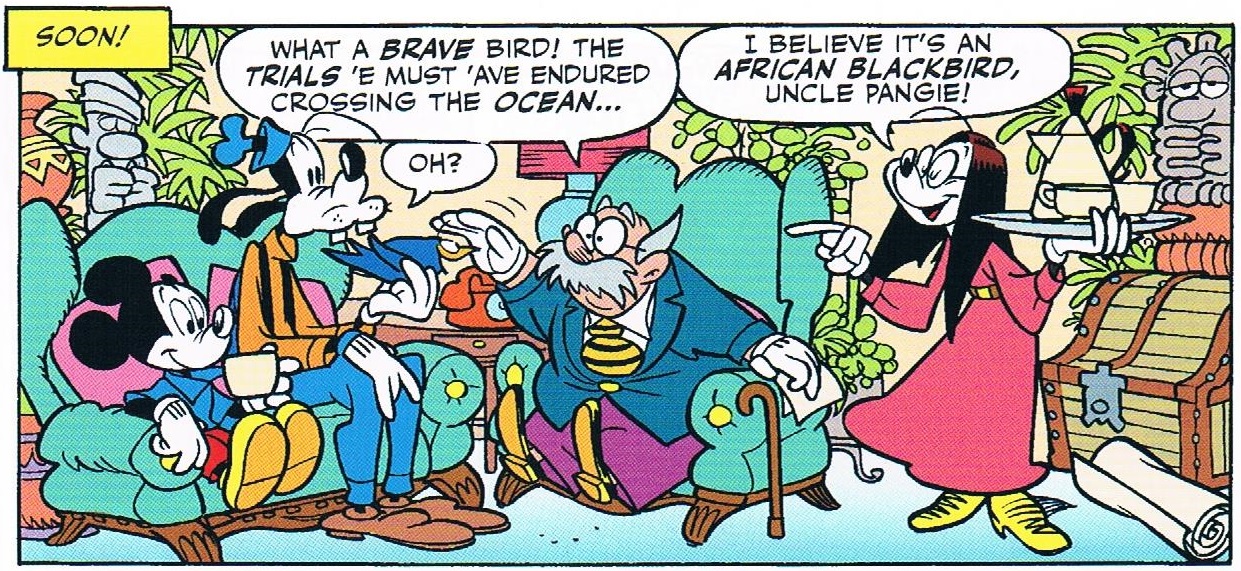
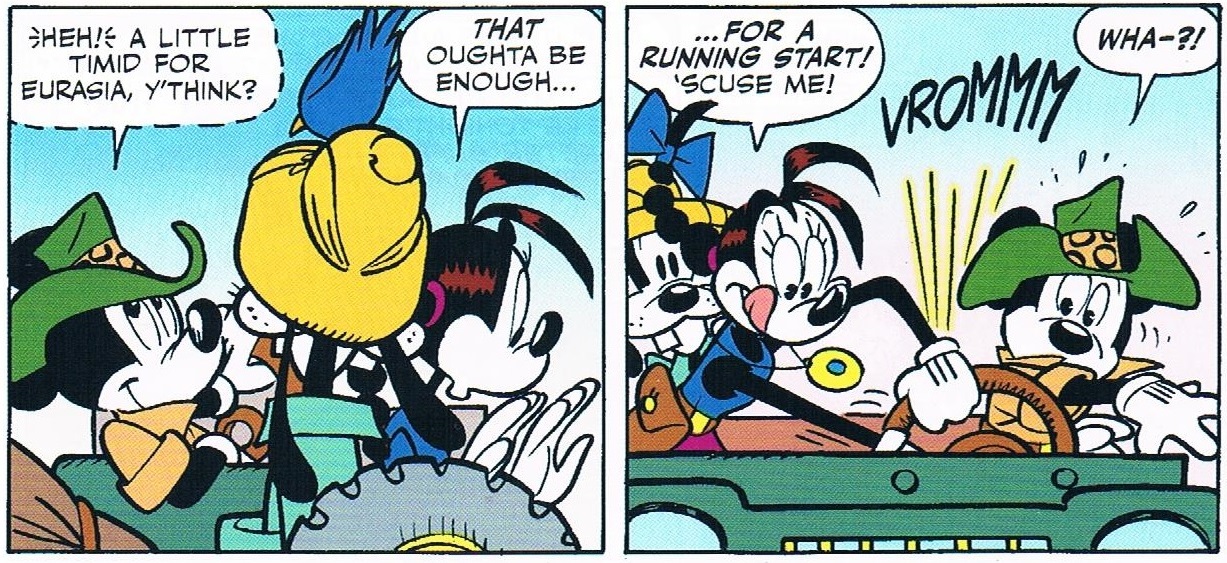
The real hero of “The Lost Explorers’ Trail” is Eurasia Toft. By all rights, it’s her story: it’s the pride, passion, and skill with which she takes up being the heir to her father’s legacy that drive the narrative. Mickey and Goofy are just along for the ride. Casty tacitly acknowledges this fact with M&G's very reason for accompanying Eurasia (they want to see how things turn out, as if they’re the reader), and how they become privy to the situation in the first place: a letter meant for Professor Toft is mistakenly delivered to Mickey’s address. It’s to Casty’s credit that I didn’t really notice this the first time through. Their enthusiasm for and earnest curiosity for the mission sells this case of tentative plot logic, which is then reinforced proactive initiative Mickey and Goofy take in a least getting through the adventure, even if they don't really have an impact on much of what happens. More often than not, Eurasia takes the lead...


...but Mickey and Goofy prove worthy partners in her adventure, weathering its perils just as well:


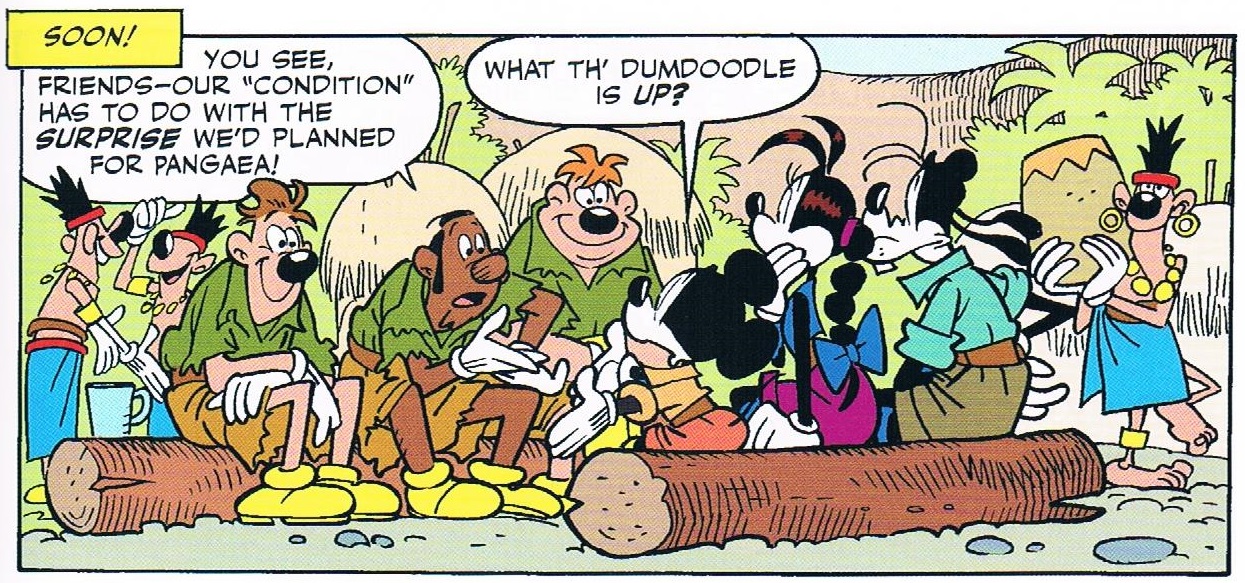
Arguably, Goofy is more extraneous than Mickey, but the opening “pancake contest” scene establishes a joined-at-the-hip “bosom buddies” camaraderie that continues to be exhibited throughout the story, distinguishing it from all those stories where Goofy is pretty much just there. I like Casty’s take on him here: while he’s aware of what’s going on and as and fully engaged as Mickey. See how they're equally at rapt attention here:


Or how Goof correctly notices something important BEFORE Mickey does:


But of course, when someone screws up, it's inevitably going to be Goofy... innocently enough:


I’m not sure what to make of Eurasia, really. My knee-jerk reaction is that I’m not too keen on the employment the “nebbish librarian type who takes off her glasses and is suddenly an ass-kicking hot chick” cliché. (I’m taking it that her mom was a mouse, as her dad isn’t? Hey, I guess what proves that she’s a major character is that she has a Mickey/Minnie-style head, despite her taller height and creepy humanoid body.) In fact, all of the incidental characters in her orbit and the “part” each plays feel very familiar. There's her “jolly”, affable, intellectual, accomplished, now retired father, Pangea, who because of his pure, boundless love for his field, cannot truly forget the mystery he left unsolved and his missing friends. But he has great pride in his daughter, the bona fide apple-of-his-eye, and sees in her hope to finish what he couldn't. Then there's Pangea's equally spirited and insatiably curious adventure chums of academia. And finally, there's their corrupt, backstabbing, deceitful former peer. Even the way the secret valley’s biggest secret turns out to be able to cure Pangea's rheumatism, actually.  I’m not saying this familiarity is a bad thing – I’m just observing it. It’s worth noting, though, that when I lay all that out, it becomes apparent that this is more of a Eurasia Toft story than a Mickey Mouse story, eh? 

...look, they even KNOW it!


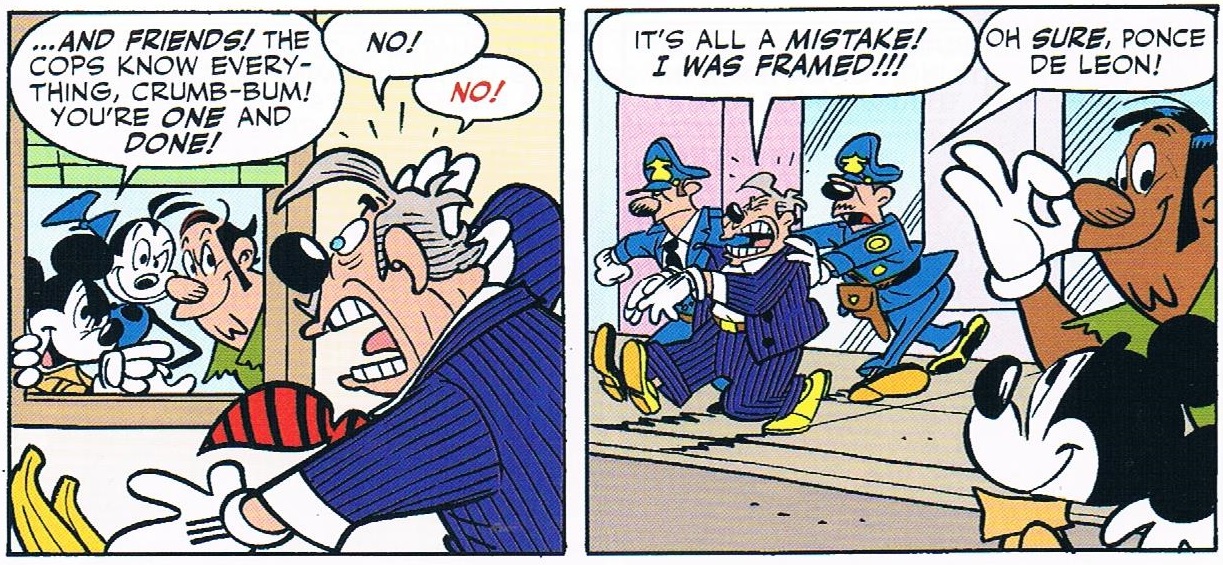
Regardless, it IS a Mickey Mouse story in that it was intended and produced as one, and, hey, having adventures is what Mickey does in comics, so the writers have to come up with reasons for him to have new ones, right? As archetypal as the new and/or incidental characters might be, Casty defines them with acute clarity and tells their story with airtight plotting. It struck me as unusually, almost realistically dark for a Disney comic how insidious the villain actually is, in having appeared to be an upstanding citizen but having actually left his friends for dead decades earlier. As fatal as most Disney comic villains’ intentions might be, the effects of their ill actions are usually attempted and thwarted in a linear span of time contained within one story.


As reflected in (in addition to the almost trans-Mickey plot and trans-Mickey cast) Cavazzano’s (literally) edgy, feisty, "zinging" art and the modern slang used by dialogue scribe Jonathan Gray, this is neither Gottfredson’s nor Murry’s Mickey, no. Nonetheless, it IS a modern incarnation of and in the Mickey Mouse adventure comic tradition that doesn’t betray the character or the genre. And that should be commended and celebrated.
_______________

And for those inclined, the Mickey Mouse comics tradition can be celebrated with this issue’s backup features: a quintessential Don Christensen-Paul Murry 1953 Pluto story (replete with narrative/commentary captions) and two Bill Walsh-Manuel Gonzalez Mickey Mouse Sundays featuring Ellsworth, including his very first appearance. I’ve written before of how from my limited exposure to the character, I wasn’t sure who or what he was ever even intended to be. But now, at last, I know Ellsworth for the smart-aleck prankster that he is. Kudos on your editorial choices, Mr. Gerstein. Ellsworth is now squarely established for further IDW appearances.


-- Ryan

Sunday, May 10, 2015

New comic review: Uncle Scrooge #1 (#405) (IDW, April 2015)


Despite the four-year interim and the change in licensee, Uncle Scrooge #405 is pretty consistent with #404: the spotlight is on a Romano Scarpa-drawn story from 1996, represented with a new cover by Giorgio Cavazzano. David Gerstein was working on the book then, as he is again, but he's reclaimed his archival editor title from the Gemstone days. He's accompanied by Jonathan Gray and Joe Torcivia, two of his teammates from the "classics"-branded aspects of the 2009-11 licensee (though not US #404 in particular), further closing the gap, and bringing a certain level of reassurance to fellow fans who know them.


Rodolfo Cimino and Scarpa's "Gigabeagle: King of the Giant Robot Robbers" (its new American title, paying homage to Barks' own Beagle Boys-giant robot story from only a year earlier, and I suspect that the "Giga" prefix is a reference to some of sort pop culture giant robot that that I don't know about) definitely has a gargantuan Beagle Boy robot stomping across Duckburg and making off with the money bin, but there's not much of a plot facilitating those events. The setup is arbitrary on multiple fronts: we open on Scrooge freaking out arbitrarily over the general existence of the Beagle Boys ... not because of a specific recent  threat from them, and not from news of a prison break or intel on their latest scheme, but from the lack of any news about them. The nephews arbitrarily decide that they will set Scrooge at ease by bringing him to Donald and their house, where for some reason he wolfs down all of the food they can pile on his plate (Scrooge has a binge eating disorder? Or does he just normally starve because he's so cheap?), and then arbitrarily decide that the ultimate solution to his anxiety is to take him camping. The actual plot reason for this camping trip is for the ducks to discover the robot ... because that only could happen if they went camping, right?

But this fast-and-loose, half-assed plotting has nothing on the story's resolution: "Gigabeagle" has gotten away free and clear with the bin, and so it would appear time for the final act of the story, in which the ducks will figure out a way to take down (or take control of, as Scrooge did in this story's Barks precedent) the marauding skyscraper-sized motorized machine with the visage of a Beagle Boy and regain possession of the money bin. Suddenly, in one fell swoop, "Gigsie" is destroyed and the money bin is back on Killmotor Hill. Gigsie's explosive end delivers on some clever foreshadowing. I'm not sure if the "he was programmed to think like the Beagles, and so it was their greed that in the end brought about their defeat" angle was in the raw translation, but kudos to Jonathan Gray if he layered it in. However, I have a nagging suspicion that Gray saved the restoration of the money bin from being a jaw-droppingly absurd, improbable coincidence. Going by the art alone, it would appear that the explosion hurls the money bin over Duckburg and right back into its original position. This is only justified by the "big underground magnets [that] hold [the] bin to its foundation" mentioned by one of the nephews on pg. 3. Since these magnets, as far as I know, have never existed in any other story, and because they're only mentioned in passing in this new English dialogue but never shown, yet, at least as we Americans are reading it, are so crucial to the story's resolution, it seems to me that Gray salvaged an atrocious ending. However, if the mentions of the magnets are in fact mirroring the original Italian dialogue, I'll stand corrected.

(There's also the matter of the nephews for some reason signaling the police with the tiny flame of a common wax candle, but I'm gonna chalk that up as just some Italian thing.)

Nonetheless, Scarpa's art, which has a lot of busy, frantic, exaggerated, comedic hijinks, is a lot of fun. His big, bold, sweeping style certainly works well for giant robot action. Between that and all of the electrified panels of the ducks scrambling to stave off Gigsie's attack on the bin, things move with a rollicking momentum, ensuring that IDW has made a big splash in bringing back to the States not just Uncle Scrooge but the whole classic Disney comics line.

The best of Scarpa's art, with all its zest and zing, is brought out by the zing and zest of Gray's dialogue, which demonstrates that he knows duck comics inside and out, and not just because of the many references to the medium's past ("Wak!" is never exclaimed in this particular story, but the radio station that Scrooge tunes into uses the call letters "K-WAK"; when Scrooge bashes his own head against the wall to get ideas, he acknowledges that a similar technique is used by a certain inventor; the Beagle Boy love of prunes comes up, as is only right; and even a reference to the title of Barks' first Uncle Scrooge adventure), but due to the Barksian dialogue -- and by that, I don't just mean particular phrases like "Good work, infants!", but the cadence and rhythms, and the way tone and timbre signifies characterization, which is perfectly consistent with the characters that we know. And though there are some modern quirks (a reference to a Red Bull advertising slogan and terminology like "A.I."), there's a lot more absolutely delightful eccentricities that would seem to belong to Barks' or even Gottfredson's era but as far as I can tell, are original: "GREAT HOWLIN' CRASHWAGONS!", "Hot crawdads, Unca Donald was right!", "We need that salty codger alert!"  Gray also does a fine job continuing the tradition of comic book tradition onomatopoeia, both in the expressions used and the way they're puncuated.

And I would be remiss if I didn't mention Gray's DuckTales references: there's a variation on Scrooge's "Jumpstart my heart!" and a pun on the name of the Beagle Boy who most of often led the gang on the show. It should go without saying that I appreciated these!


The original Italian title of #405's backup story translates to "The Secret of the Coat", a dry title that evokes the mystery-adventure genre, when the story is actually more in the sitcom vein. So Joe Torcivia's new, comedic title, "Stinker, Tailor, Scrooge and Sly" (I just figured out what that's a pun on -- it's something I'd never heard of; I won't give it away, so that if you have, you can relish it; and if you haven't, do your own damn Googling!) is more fitting for this light-hearted romp with the mismatched "odd trio" of Scrooge, Brigitta, and Jubal Pomp built around a cliché: finding a treasure map drawn on one's own piece of property and unraveling its mystery while clashing with a mysterious villian who who has shown up out of nowhere and we learn is connected to the map's past. Now, this is the stuff of countless exciting, full-developed stories in feature film, pulp novel, and duck comic, but this particular narrative offers little more than a couple chase sequences, with the good guys and the bad guy sparring in a game of "hot potato" (or football) with Scrooge's coat, and the villains' anticlimactic surrender to the police ... for which Scrooge and Co. are basically just bystanders!

On top of the banal narrative, this is recent, slicker, more on-model Scarpa, which I find duller than his squashier '50's and '60's work. By far the most vital, entertaining part of the story is the dynamic between Scrooge, Brigitta, and Jubal, with Scrooge having an aversion to both (but for different reasons), Jubal making no secret of his distaste for (and envy of) Scrooge, Brigitta's crush being tempered by her indignance at Scrooge's stinginess and his contempt for her, Brigitta and Jubal agreeing to suck upand  pander to Scrooge in the hopes of cajoling him into investing in their business, and Scrooge tolerating their scheming so as to use them for his own ends -- first for a complementary coat mend, then the use of Jubal's car when chasing the villain, which Jubal and Brigitta join Scrooge in, hoping to get a cut of the treasure. In the last panel, it appears, via the illustrated thought balloons, that all three parties have played each other and made the right compromises so that each is (at least anticipating) getting what they want. If it weren't for these visuals, the Scrooge-Brigitta-Jubal dynamic would have been out of play at the end of the tailor shop scene, for their tagging along for the arrest and subsequent finding of the treasure would be, as Scrooge describes Jubal in my favorite of Torcivia's jokes in story, "superfluous" to the plot.

Torcivia steadily delivers puns and various other types of wordplay, references (including ripping on Minnie Mouse -- more the Minnie Mouse of mass merchandising than anything -- and her taste in clothing design), and irreverent goofs on everything from "mall cops" to the fashion industry, giving American readers a feisty read. As Gray fixed what I was suspect was a massive hole in the lead story, Torcivia not only ties Barks' Brutopia into the villain's back story, but with said back story, assures us that the map has only been a part of Scrooge's coat for 10 years and not since he acquired it, avoiding any flirtation with dicey continuity. Based on the characters' poses and instructions, the characterizations of the "odd trio" were very much part of the original story, but with all of the insults, jabs, and acerbic sarcasm thrown between them, Torcivia maximizes the potential. I'm not sure why this unexceptional story (though Torcivia has added a lot of tasty seasoning for flavor) was selected for this issue. But if the idea was to begin IDW's run by establishing to the readership Brigitta and Jubal as characters, and moreover their entrepreneurial partnership (for we've seen a fair amount of Brigitta here over the years here, and not too much of Jubal), then it's a very suitable choice.

Gerstein closes the issue with an editorial reviving the "Crosstalk" banner, which definitely made this fan feel at home. After giving some background info on the Beagle Boys, Brigitta, and Jubal, Gerstein closes by sharing a sentiment that affirms that these comics are in expert, loving hands.

-- Ryan

Wednesday, March 14, 2012

Retrieved From Storage: Donald Duck Adventures #19 (Gemstone, July 2006)

I've mentioned in past posts that for most of the Gemstone era, I'd quit reading and collecting comics for the second (and, as far as I'm concerned at the present moment, last) time in my life. Over the past couple years, I've been catching on what back issues I've been able to find in a couple shops in Connecticut.

Recently, I read this issue for the first time. I enjoyed it, and found much to commend in it, more so than on average. Here's the cover, attributed by Inducks to Massimo Fecchi:


The style in which the regular characters, Donald and the nephews, are rendered, especially with the slick digital coloring and the shading effects, resembles how they would appear in (relatively) modern, "official" Disney studio-produced animation, no? (I suppose DuckTales -- especially the more cartoony, elastic-y later episodes, or the series of Christmas-themed direct-to-DVD specials, would have to be our primary points of comparison.) The immediacy of the perspective and the emphasized action also contributes to the drawing's (psuedo-) animated quality.

_______________________
 
 
With its depiction of the ducks being menaced by a Viking warrior, the cover shown and discussed above represents the lead story, "Where's the Bin Been?", written by Pat and Carol McGreal and drawn by Flemming Andersen. Dominated by time travel, it's a compelling (and worthy) counterpart to "The Bathtub at the End of the Unverse"/"The Bathtub at the Edge of Forever", published only two issues earlier, in #17, and which I wrote about (and gave high praise to) in a previous post. Interestingly, "Bathtub" was also drawn by Andersen, but written by Michael T. Gilbert. Nonetheless, both stories share similar characteristics of inventiveness, sharp plotting and characterization, and balancing high-stakes drama with humor that seems to naturally proceed from the plot and characters.

Time travel stories are commonplace in comics and other mediums in which genre fiction prospers, but to my delight -- avoiding spoilers -- the time travel scenario that the McGreals devised here is original and exceedingly clever. (Hint: the dilemma/conundrum that spurs the plot rolling is inevitably resolved at the end, by way of a twist reveal. Let's just say that the history of the money bin's presence in Duckburg ends up considerably retconned!)

Of course, a lesser writer would send the ducks on this particular mission, assume that the plot could carry them, and have them act more less like robots acting together as one. Of course Scrooge wants to figure out where his fortune's gone and recover it ... but his shifts between, depending upon how things develop from one beat to the next, despair, gung-ho determination, and mortal fear are dead-on (especially with Andersen's exaggerating renderings -- when appropriate, Scrooge's visage is comparable to the famous painting by Evard Munch, "The Scream"!)

Donald's eagerness to get this particular adventure underway at first strikes one as being a bit out-of-character. But the McGreals sell it once it becomes apparent that his pop culture indulgences have inspired him to brazenly, myopically pose as a brave adventurer. Once the ducks are faced with the Viking threat, Donald even goes so far as to pose as a Norse god ("Those bozos are a superstitious lot! They believe in gods like Thor! I should know! I read the comic books!"), delusionally certain that he'll immediately scare them off. (And then it goes nothing like he'd thought it would. Who ever would have seen that coming?!) Jeopardizing the mission and causing Scrooge several more heart attacks, the dissonance between Donald's slacker "unseriousness" with Scrooge's disciplined, shrew, miserly "seriousness" is well in keeping with Barksian tradition, expertly staged in a way that's unique to and integral to this story. All the more admirably, the failure of Donald's disguise proves to not be an arbitrary, passing gag, but a well-laid-out plot thread, and the crux of Donald's role in the story, coming to a head as one of the mutually complementing multi-twists of the climax and denouement.

Like so often in Barks' stories, the nephews are dedicated to assisting Scrooge in his objectives, scrambling to solve problems when they arise and more than once making deductions before the two adult ducks do -- in other words, being exemplary Junior Woodchucks. However, the McGreals -- and possibly even more so -- Andersen never mistake the nephews for conditioned, reflexive little soldiers. When the ducks are in a jam and a solution isn't yet apparent, the nephews are obviously worried and/or afraid. They're human (...for all intents and purposes!), after all.

_______________________


Make no mistake -- I thought that "Where's the Bin Been?" was great. Still, the story that really solidified my favorable disposition to this issue was its second feature, a Mickey Mouse story, "The Wind of Azalai", written by Augusto Macchetto and drawn by Guiseppe Dalla Santa. Though I'm not familiar with either creator, they did a bang-up job! I am perfectly fine with, in general, the heavily exaggerated, highly stylized art that typifies many, many European Disney comics, and I consider folks such as Andersen (as evidenced above), Cavazzano, etc. to be exemplary cartoonists. Nonetheless, I'll admit, sometimes it's just plain refreshing to see these characters, and an entire story, drawn in a "conventional", more "straight" fashion, as Dalla Santa does here!

Furthermore, this is a classical adventure story, set in the unforgiving Sahara and replete with an ancient mystery, a hidden civilization, the revelation of unexpectedly advanced ancient technology and science, and ruthless desert-dwelling hordes of rogues/bandits! In other words, it's right up my alley! The plot point of Mickey and Co. getting lost in a ferocious sandstorm and winding up held captive in the aforementioned "hidden civilization" brought to mind DuckTales' "Master of the Djinni"! Consequently, at first, I was sure that the storm had transported back in the time, and some of the more dramatic score music used heavily in DuckTales' adventure-dominated first season crept in to my head, and stayed there `til the end of the story!

Admittedly, it's a bit more contrived than "Bin Been?" But the ultimate solving of the "gold and salt" enigma is clever and original enough. The story's strongest point is Macchetto's conception of, and Dana Salla's depiction of, the underground wind tunnel and air-raft.

_______________________


Most issues of Gemstone's Adventures digests encompassed three lengthy, solid European stories. However, after "Azalai", the rest of the issued is filled out by a few shorter works and a smattering of gags, ranging in length from one to several pages. When I realized this, I balked, but overall, I discoverd that the material held up quite well.

A Beagle Boys story, "The Black Sheep" entailed qualities of whimsy, absurdism, and yet kind-natured earnestedness that reminded me of Sergio Aragonés. Writer Francesco Artibani's posits two Beagles Boys' relating to Grandpa Beagle how it happened that they "blew another caper!" Their narration is contrasted against a visual flashback that the readers, but not Grandpa, are privy to, revealing what they're leaving out and how they're downplaying their follies. Somewhat Rashomon-esque, Artibani gives the time-tested "disparate account" trope his own spin. Realized via Silvia Ziche's distorted art, in which little is rounded, opting for pointy angles and blocky shapes, and favoring over-the-top, frenzied poses and facial expressions, this is a tasteful example of slapstick and comedic characterization.

The standout of the issue-rounding-out lot, to me, was "Inside Donald Duck" -- another Andersen-drawn story, this one written by Mark and Laura Shaw. Yet again, Scrooge and Donald's differences are played up, this time to the hilt -- the phrase "oil and water" doesn't even begin to capture how badly things go here, all as a result of them being unable to get along and driving each other (...or, perhaps more aptly, themselves?) incrementally crazier and crazier. In fact, the story's opening brought to mind that of "Back to the Klondike": set in the bin's office, something -- naturally, involving his money -- goes wrong, and Scrooge panics, to the point of hysteria ... though in "Klondke", Donald was a bemused bystander for Scrooge succumbing to his neuroses, here, they're i.e. at each other's throats. The blundering escalates, resulting in the necessitation of a visit to the doctor's office -- the next scene, which we promptly cut to.

Breaking away from the "Back to the Klondike" parallels, the doctor fails to help Donald ... thus, the really bad thing that Donald had happened is still really bad, and so he's nervous wreck, and the really bad thing gets worse and even more worse, and it turns out that this is one of those "Donald tries to do something right, but he messes up, and before you know it, he's left a path of destruction clear across Duckburg" stories. And it's one of the highest order! It's tightly plotted, and masterfully executed on the visual end of thigns by Andersen -- I'll repeat what I said said about Ziche's "Black Sheep" art: with Andersen's "distorted art, in which little is rounded, opting for pointy angles and blocky shapes, and favoring over-the-top, frenzied poses and facial expressions, this is a tasteful example of slapstick and comedic characterization."

As the issue winds down, we encounter a six-page Romano Scarpa Mickey Mouse story. To me, it tries a little too hard to be some sort of humorous moralistic fable, but it comes off as hamfisted, and its attempts at twist plot points and irony are a bit too forced. Originally from 1973, the incidental dogface characters (a crook and two police officers, the crook and one of the officers with the portly shape Scarpa often uses that I think was inspired by Gottfredson's Chief O'Hara) hint at Scarpa's funny animal cartooning at its best. But on the other hand, Mickey looks a little strange -- it looks like his snout's been mangled! Finally, just who the heck is this "Ellsworth", an apparent sidekick or partner of Mickey's!

And then, the issue closes out with two decent/average one-page gags. To keep things proportionate, that's all I'll say about them! :)